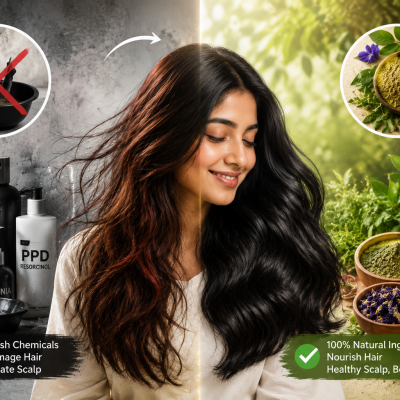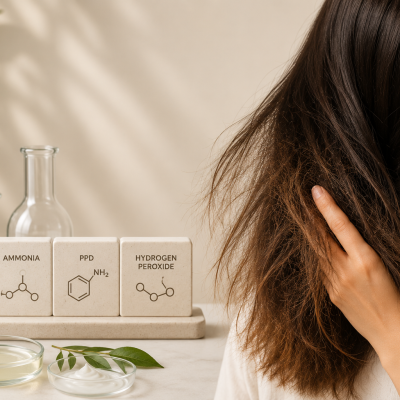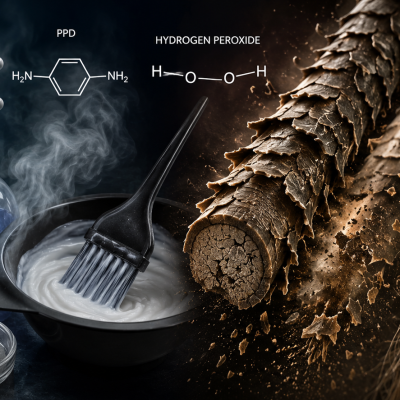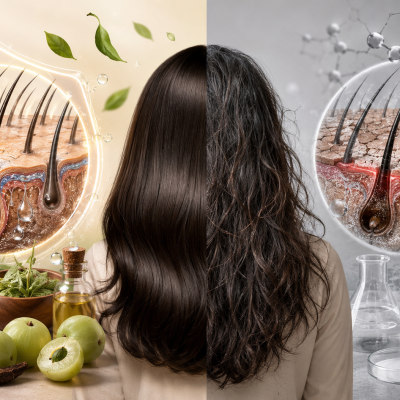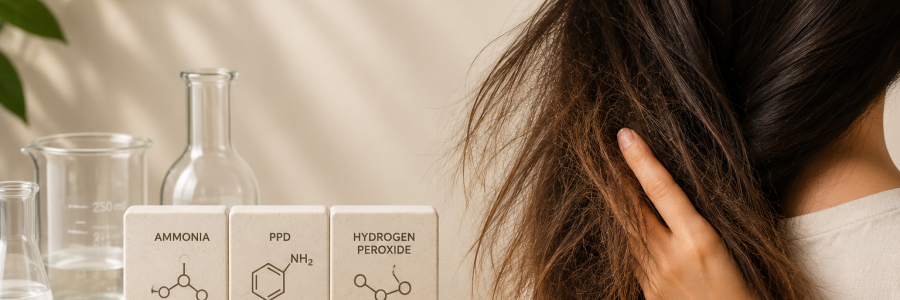
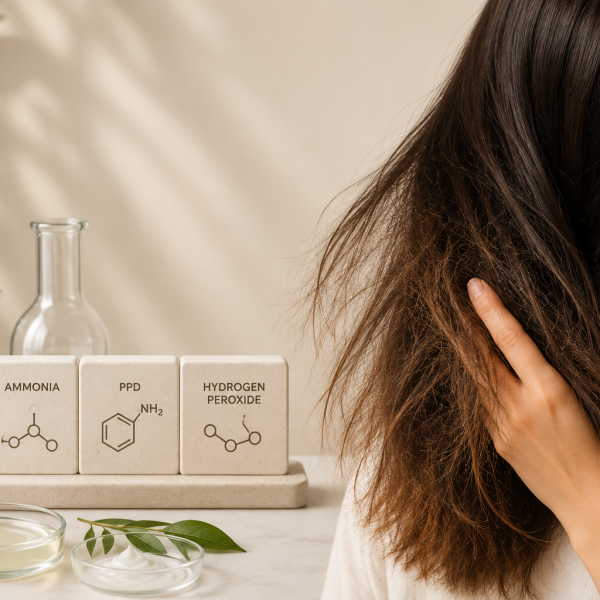
Chemical hair colors are widely used for their ability to provide long-lasting and vibrant shades. However, achieving these results often requires the use of powerful chemicals such as ammonia, hydrogen peroxide, PPD, and so-called “ammonia-free” alternatives. While these ingredients effectively alter the hair’s natural structure to deposit color, growing scientific evidence suggests that repeated use of chemical hair colors may compromise hair integrity, disrupt the scalp’s natural balance, and increase the risk of irritation or allergic reactions. Understanding how chemical hair colors interact with the hair and scalp is essential for making informed choices that support long-term hair and scalp health. Read More
Let's Discuss
1. Ammonia: How It Affects Hair and the Scalp
Ammonia is a colorless gas made of nitrogen and hydrogen and is highly alkaline. In chemical hair colors, ammonia is commonly used because it effectively opens the hair cuticle, allowing color molecules to penetrate the hair shaft. However, this process also strips away some of the hair’s natural protection (Bailey et al.). Because it evaporates quickly, ammonia produces the strong, pungent smell commonly experienced during hair coloring treatments (Bailey et al.).
Exposure to ammonia fumes from chemical hair colors can cause temporary irritation of the eyes, nose, throat, and respiratory tract (Palaniappan et al.). Direct contact with the scalp may also lead to skin irritation or contact dermatitis, causing redness, itching, and, in some cases, chemical burns, especially in individuals with a weakened skin barrier (Zanoni et al.). Understanding the role of ammonia in chemical hair colors is important for evaluating their potential effects on long-term hair and scalp health.
2. Hydrogen Peroxide: How It Changes Hair and Causes Damage
Hydrogen peroxide used in chemical hair colors can remove essential oils and damage the protective 18-MEA lipid layer, which is responsible for the hair’s natural shine and water resistance (Ali et al.). These lipids are easily broken down by alkaline conditions and oxidation, leaving the hair permanently more vulnerable to moisture absorption and environmental damage (Ali et al.).
👉 Repeated use of chemical hair colors may cause hair to become rougher, harder to comb when wet, more prone to breakage, and chronically dry over time (Ali et al.).
Join the Journey Back to Natural Hair Care
We are building more than just products—we are building a community
that believes in thoughtful, effective, and responsible hair care.
3. The Truth About "Ammonia-Free" Hair Colors
To address consumer concerns about the strong smell and irritation caused by ammonia, many companies now market chemical hair colors labeled as “ammonia-free” as gentler or safer alternatives. However, scientific evidence suggests that replacing ammonia with other alkalizing agents—such as Monoethanolamine (MEA) or Aminomethyl Propanol (AMP)—does not necessarily make these products less damaging. In reality, “ammonia-free” does not mean “damage-free.” These alternative chemicals used in chemical hair colors still raise the hair’s pH to allow color penetration and, in some cases, may cause equal or even greater structural damage to the hair than ammonia itself (Bailey, et al).
Monoethanolamine (MEA): The Hidden Cost of “Ammonia-Free” Chemical Hair Colors
Since it does not evaporate easily, MEA can remain on the hair and scalp even after rinsing, leading to prolonged exposure (Bailey, et al). Scientific studies using techniques such as Fourier transform infrared spectroscopy (FTIR), scanning electron microscopy (SEM), and protein analysis have shown that MEA can cause significant damage to hair fibers. Research has found that exposure to a 5% MEA solution can result in severe surface damage and breakdown of hair proteins (Ali, et al). Mechanical testing has also shown that hair treated with 5% MEA can lose about 25% of its strength after just one hour of exposure, with prolonged exposure leading to around a 50% reduction in mechanical strength (Ali, et al). Some comparative studies have reported that MEA-based formulations used in chemical hair colors may cause substantially greater structural damage and protein loss than comparable ammonia-based systems under certain test conditions (Bailey, et al). This damage can leave hair more porous, weaker, and more prone to breakage (Bailey, et al).
In addition, studies suggest that the combination of MEA and hydrogen peroxide, commonly used in chemical hair colors, may increase oxidative stress and cellular damage in human keratinocytes and may contribute to skin irritation and dermatitis. In some cases, such damage has been associated with chemically induced hair shedding, including telogen effluvium (Zanoni, et al).
Aminomethyl Propanol (AMP): A Growing Safety Concern in Chemical Hair Colors
Although AMP was previously considered safe at low concentrations, recent toxicological assessments have raised significant concerns. The European Chemicals Agency (ECHA) Committee for Risk Assessment (RAC) has proposed a harmonized classification of AMP as a Reprotoxic 1B (CMR) substance, indicating that it may be toxic to human reproduction (Palaniappan, et al). In addition, the RAC has classified AMP as corrosive to the skin, capable of causing serious eye damage (Category 1), and harmful to the liver after repeated exposure (Palaniappan, et al). As a result, AMP is on a regulatory path that could lead to its prohibition in cosmetics in the European market under Article 15 of the Cosmetics Regulation, highlighting the potential risks associated with some “ammonia-free” chemical hair colors (Palaniappan, et al).
PPD and Chemical Hair Colors: Understanding the Allergy Risk
When PPD, a common ingredient in chemical hair colors, comes into contact with the skin, it can bind to skin proteins and trigger an immune response. The body’s immune system creates memory cells that recognize PPD, meaning that once a person becomes sensitized, future exposure can cause an allergic reaction (Zanoni, et al). This reaction, known as Allergic Contact Dermatitis (ACD), usually appears within hours or days after exposure. Mild symptoms may include itching, dryness, and rashes around the scalp, ears, or eyelids (Palaniappan, et al). In more severe cases, it can cause redness, blistering, fluid-filled skin lesions, and significant swelling of the face and neck (Palaniappan, et al).
In rare but serious cases, PPD allergy associated with chemical hair colors may lead to widespread skin reactions, breathing difficulties, asthma, kidney problems, or even anaphylaxis, a life-threatening allergic reaction (Zanoni, et al). Once someone develops a PPD allergy, it is generally lifelong, and repeated exposure to chemical hair colors containing PPD can trigger increasingly severe reactions (Palaniappan, et al). People who are allergic to PPD may also react to related chemicals found in textile dyes, local anesthetics, and some cosmetic ingredients due to cross-sensitization (Zanoni, et al).
👉 Importantly, many products marketed as “ammonia-free” still contain PPD or closely related ingredients such as Toluene-2,5-diamine sulfate, meaning they may still carry the same allergy risks (Zanoni, et al).
4. Long-Term Effects on Hair and Scalp Health
Repeated use of high-pH chemical hair colors can create an ongoing cycle of damage. Over time, these chemicals weaken the hair’s protective cuticle, change its natural structure, and affect the overall health of the scalp.
As this damage builds up, the hair becomes more porous, weaker, and more prone to dryness and breakage. At the same time, the scalp is repeatedly exposed to chemical stress, making it harder to maintain its natural balance. Instead of returning to a healthy state, the hair and scalp may remain in a constant cycle of damage and repair, leading to long-term structural and physiological changes.
5. Cuticle Damage and Loss of Moisture Balance
When ammonia—or alternatives like MEA—forces the hair cuticle to open, the cuticle does not always return to its original smooth and flat position. Repeated chemical exposure can permanently damage the cuticle structure, making the hair highly porous (Bailey, et al).
As a result, the hair loses its ability to regulate moisture properly. It absorbs water from the environment too quickly in humid conditions, causing swelling and frizz, and loses moisture just as rapidly in dry conditions, leading to dehydration (Bailey, et al).
These constant changes in moisture levels can make the hair dry, brittle, and less flexible. Over time, this increases the risk of breakage, mid-shaft damage, and split ends (Bailey, et al).
6. Conclusion
Hair coloring is a personal choice, but understanding the chemistry behind commonly used hair dyes is essential for making informed decisions. Scientific evidence shows that ingredients such as ammonia, hydrogen peroxide, PPD, and even some “ammonia-free” alternatives can alter the hair’s natural structure, weaken its protective barrier, and expose the scalp to repeated chemical stress. Over time, these changes may contribute to dryness, breakage, irritation, and increased sensitivity. While chemical dyes offer convenience and long-lasting color, consumers should carefully weigh their benefits against their potential long-term effects on hair and scalp health and consider safer, gentler alternatives that align with their individual needs and preferences. Buy 100% Natural Hair Color
7. References:
- Ali, N., Marsh, J., Godfrey, S. and Williams, D.R. (2018) ‘Aqueous MEA and Ammonia Sorption-Induced Damage in Keratin Fibers’, ACS Omega, 3(10), pp. 14173-14180. Available at: https://pubs.acs.org/doi/10.1021/acsomega.8b01189
- Bailey, A.D., Zhang, G. and Murphy, B.P. (2014) ‘Comparison of damage to human hair fibers caused by monoethanolamine- and ammonia-based hair colorants’, Journal of Cosmetic Science, 65(1), pp. 1-9. Available at: https://pubmed.ncbi.nlm.nih.gov/24602818/
- Market Growth Reports (2024) Hair Colour Market Overview. Available at: https://www.marketgrowthreports.com/market-reports/hair-colour-market-105888
- Palaniappan, V., Karthikeyan, K. and Anusuya, S. (2023) ‘Dermatological adverse effects of hair dye use: A narrative review’, Indian Journal of Dermatology, Venereology and Leprology, 90, pp. 458. Available at: https://ijdvl.com/dermatological-adverse-effects-of-hair-dye-use-a-narrative-review/
- Zanoni, T.B., Hudari, F., Munnia, A., et al. (2015) ‘The oxidation of p-phenylenediamine, an ingredient used for permanent hair dyeing purposes, leads to the formation of hydroxyl radicals: Oxidative stress and DNA damage in human immortalized keratinocytes’, Toxicology Letters, 239(3), pp. 194-204. Available at: https://pubmed.ncbi.nlm.nih.gov/26456176/