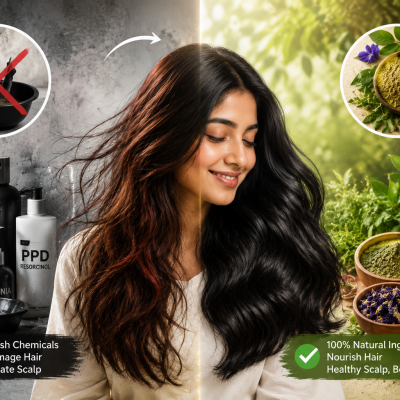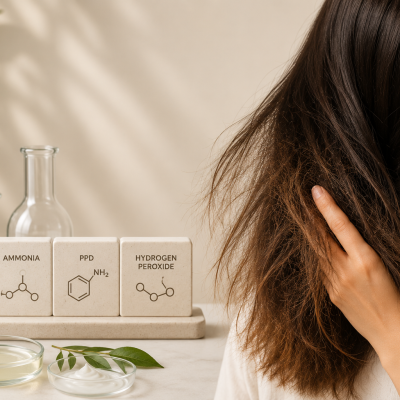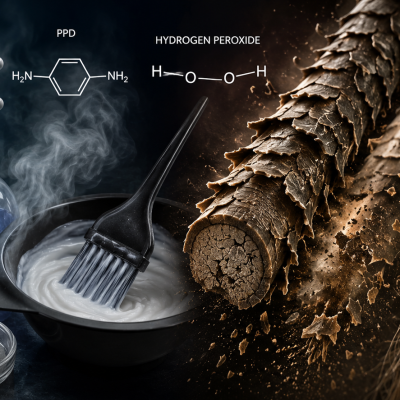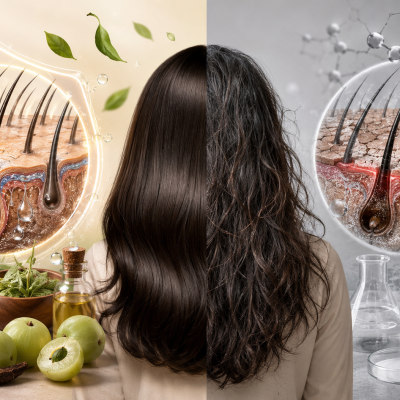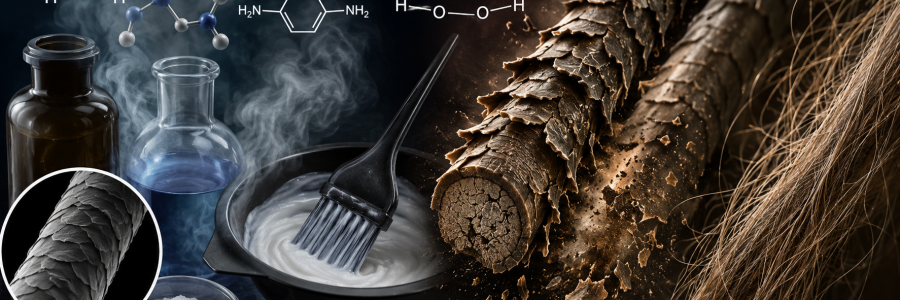
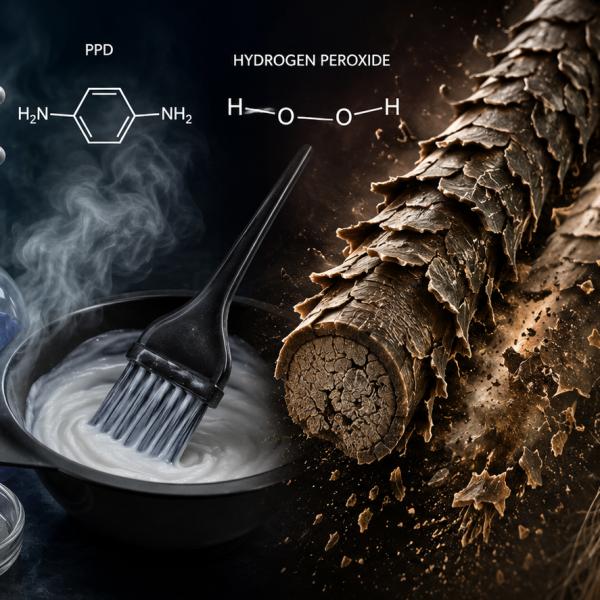
The growing demand for cleaner products is driven by increasing awareness of the side effects associated with chemical hair colors and synthetic hair dyes. For many years, the industry has relied on strong chemical ingredients to force color into the hair shaft. Although permanent chemical hair colors account for more than 70% of the market because of their long-lasting results and effective grey coverage, they are also linked with structural hair damage and scalp sensitivity (Palaniappan, et al). In India, consumers are increasingly looking beyond color performance and seeking products that are gentler on the hair, protect the scalp, and support the natural scalp microbiome (Palaniappan, et al). Understanding these concerns requires a closer look at how chemical hair colors interact with the structure of the hair fiber and why many people are now exploring safer alternatives.
Let's Discuss
1. Understanding Hair Pigmentation and the Hair's Natural pH Balance
To understand how chemical hair colors can damage hair, it is important to first understand how healthy hair is naturally structured. The hair shaft is mainly made of keratin, a strong protein rich in sulfur. Its outer layer, called the cuticle, is made up of overlapping scales that protect the inner cortex, where melanin gives hair its natural color. The cuticle is also covered with a natural fatty layer called 18-methyleicosanoic acid (18-MEA), which helps repel water, reduce friction, and keep hair smooth, shiny, and easy to manage (Ali, et al).
Another important property of hair is its isoelectric point, which is the pH at which the keratin proteins carry no overall electrical charge. For human hair, this natural balance lies between pH 3.4 and 4.5 (Ali, et al). Read more. At this pH, the cuticle remains flat and tightly closed, moisture stays locked inside, and the hair is at its strongest because the protein structure remains stable (Bailey, et al). In this state, the hair is naturally well-protected and less reactive to external damage.
When hair is exposed to products with a very different pH, especially highly alkaline products, it moves away from this natural balance and experiences structural stress. The hair develops a strong negative charge, causing the cuticle scales to repel each other and lift away from the hair shaft (Bailey, et al). While this opening of the cuticle allows synthetic dyes to enter the hair, it also disrupts the hair’s natural structure and can contribute to long-term damage.
2. Types of Chemical Hair Colors
Chemical hair colors are not all the same. They differ in how deeply they enter the hair, how long they last, and the chemical process they use to create color. Some products simply coat the surface of the hair, while others penetrate deep into the hair shaft and permanently change its color.
Temporary hair colors stay only on the outer surface and wash off easily. Semi-permanent and demi-permanent colors penetrate the hair to different depths and last for several washes. Permanent hair colors go the deepest, using chemical reactions to open the hair cuticle and deposit color inside the cortex, making the change long-lasting.
Colorant Classification | Chemical Mechanism and Dye Composition | Depth of Penetration | Longevity and Developer Requirement |
Temporary Dyes | High-molecular-weight direct dyes, such as Acid Yellow 23 and Acid Red 92, mainly stay on the surface of the hair. They attach to the hair through weak physical forces like van der Waals forces and electrostatic interactions, without causing any chemical reaction inside the hair fiber (Palaniappan, et al). | These dyes remain on the surface of the hair’s cuticle and do not penetrate into the inner cortex of the hair (Bailey, et al). | Lasts 1 to 2 washes. No developer or alkalizer required (Palaniappan, et al). |
Semi-Permanent Dyes | Low-molecular-weight direct dyes, such as nitro-phenylenediamines, nitro-aminophenols, anthraquinones, and basic azo dyes, are small enough to pass beneath the hair’s cuticle without the need for strong alkaline chemicals to open it (Palaniappan, et al). | These dyes reach deeper into the hair, settling beneath the cuticle and into the outermost layer of the hair cortex (Bailey, et al). | Lasts 10 to 20 washes. No ammonia or hydrogen peroxide developer required (Palaniappan, et al). |
Demi-Permanent Dyes | Uses a mild alkalizing agent along with a low-strength hydrogen peroxide developer to slightly open the hair cuticle, allowing the color pigments to settle just beneath the surface (Palaniappan, et al). | These dyes reach only the shallow layers of the hair cortex. They cannot significantly lighten the hair’s natural pigment but can effectively darken or add tone to the hair (Bailey, et al). | Lasts up to 24 to 28 washes (Palaniappan, et al). Requires a low-volume developer (Palaniappan, et al). |
Permanent Dyes | Permanent hair colors use a strong two-part chemical system with powerful alkalizing agents and high-strength hydrogen peroxide. These chemicals open the hair and create new color molecules inside the hair shaft through a chemical reaction, making the color long-lasting (Zanoni, et al). | These dyes penetrate deep into the hair cortex and permanently replace the hair’s natural melanin with synthetic color pigments (Zanoni, et al). | Permanent until the hair grows out or is chemically stripped. Requires high-volume developer (Palaniappan, et al). |
While temporary and semi-permanent hair colors are generally less damaging because they work close to the hair’s natural pH and do not require strong oxidizing chemicals, they also have limitations. They cannot provide complete grey coverage, and the color gradually fades with washing (Palaniappan, et al).
As a result, permanent hair dyes remain the preferred choice for people who want long-lasting color changes or full grey coverage. However, this long-lasting effect often comes at the cost of increased damage to the hair’s natural structure.
👉 Understanding these different types of chemical hair color is important because each works in a different way and may have different effects on the hair’s structure, scalp health, and overall safety profile.
Join the Journey Back to Natural Hair Care
We are building more than just products—we are building a community
that believes in thoughtful, effective, and responsible hair care.
3. How Chemical Hair Colors Work: A Chemical Process
Chemical hair colors work through a chemical process that uses two main components—a colorant and a developer—to create long-lasting color changes.
Instead of preserving the hair’s natural strength, these chemicals force a chemical transformation inside the hair shaft, making it more porous and vulnerable over time. The process involves three key steps: first, an alkalizing agent opens the hair cuticle; second, an oxidative developer breaks down the hair’s natural melanin; and finally, dye precursors react and form new color molecules inside the hair cortex, creating permanent color.
- Ammonia in Hair Color: How It Affects Hair and the Scalp
PPD and ammonia are two commonly used ingredients in permanent hair colors. Ammonia acts as a strong alkalizing agent, raising the hair’s pH—often above 9.0 or 10.5—to open the cuticle and allow color to penetrate the hair shaft (Bailey, et al). This high pH pushes the hair away from its natural isoelectric point, causing the cuticle scales to lift and making it easier for dye molecules to reach the inner cortex (Palaniappan, et al).
- Hydrogen Peroxide: How It Changes Hair and Causes Damage
After the hair cuticle is opened by an alkalizing agent, hydrogen peroxide acts as the oxidative developer. Its main job is to break down the hair’s natural melanin, allowing a new color to be created inside the hair shaft (Bailey, et al)
Hydrogen peroxide ($H_{2}O_{2}$) is mixed with the alkaline color cream just before application. On its own, it has a highly acidic pH, but when combined with the alkaline base, it produces reactive oxygen species (ROS) that penetrate deep into the hair cortex and oxidize the natural melanin, effectively bleaching the hair to prepare it for the new color (Bailey, et al; Zanoni, et al).
At the same time, hydrogen peroxide helps small dye precursor molecules, such as Paraphenylenediamine (PPD), react with oxygen and combine to form much larger color molecules inside the hair cortex (Zanoni, et al). Because these new molecules are too large to escape, they become trapped inside the hair, making the color long-lasting (Palaniappan, et al).
- “Ammonia-Free” Hair Colors
a. Monoethanolamine (MEA):
To create permanent hair color without using ammonia, manufacturers often replace it with Monoethanolamine (MEA), a chemical that also helps open the hair cuticle (Bailey, et al). Unlike ammonia, which is a gas that evaporates quickly, MEA is a heavier, non-volatile liquid that stays on the hair and scalp for much longer (Bailey, et al).
Because MEA is less effective than ammonia at opening the hair cuticle, it is typically used in much higher concentrations—around 6% to 10%, compared to 1.5% to 4% for ammonia-based formulations (Bailey, et al).
b. Aminomethyl Propanol (AMP): A Growing Safety Concern
Another chemical commonly used in “ammonia-free” hair dyes is Aminomethyl Propanol (AMP). It acts as a pH adjuster, creating the alkaline conditions needed to open the hair cuticle so that color can penetrate the hair shaft (Palaniappan, et al). Like MEA, AMP is used as an alternative to ammonia in many permanent hair color formulations.
c. PPD and Hair Dyes: Understanding the Allergy Risk
Apart from the damage caused by alkalizing agents and hydrogen peroxide, one of the biggest concerns with permanent hair dyes is Paraphenylenediamine (PPD). PPD is a synthetic chemical widely used to produce rich, long-lasting dark shades, especially black and deep brown hair colors (Zanoni, et al).
Although highly effective as a dye ingredient, PPD is also one of the most well-known contact allergens and has even been named the “Allergen of the Year” by the American Contact Dermatitis Society (Palaniappan, et al).
👉 While the above methods are widely used, they rely on strong alkaline chemicals that disrupt the hair’s natural pH balance and can weaken its structure.
4. Conclusion
Scientific evidence shows that many conventional chemical hair colors rely on strong chemicals such as ammonia, Monoethanolamine (MEA), Aminomethyl Propanol (AMP), hydrogen peroxide, and Paraphenylenediamine (PPD). These ingredients work by opening the hair cuticle, altering its natural structure, and creating permanent color through oxidative chemical reactions. While effective, repeated use can increase hair porosity, damage the protective lipid layer, and contribute to dryness, breakage, and scalp sensitivity (Bailey, et al; Ali, et al; Zanoni, et al).
5. References:
- Ali, N., Marsh, J., Godfrey, S. and Williams, D.R. (2018) ‘Aqueous MEA and Ammonia Sorption-Induced Damage in Keratin Fibers’, ACS Omega, 3(10), pp. 14173-14180. Available at: https://pubs.acs.org/doi/10.1021/acsomega.8b01189
- Bailey, A.D., Zhang, G. and Murphy, B.P. (2014) ‘Comparison of damage to human hair fibers caused by monoethanolamine- and ammonia-based hair colorants’, Journal of Cosmetic Science, 65(1), pp. 1-9. Available at: https://pubmed.ncbi.nlm.nih.gov/24602818/
- Market Growth Reports (2024) Hair Colour Market Overview. Available at: https://www.marketgrowthreports.com/market-reports/hair-colour-market-105888
- Palaniappan, V., Karthikeyan, K. and Anusuya, S. (2023) ‘Dermatological adverse effects of hair dye use: A narrative review’, Indian Journal of Dermatology, Venereology and Leprology, 90, pp. 458. Available at: https://ijdvl.com/dermatological-adverse-effects-of-hair-dye-use-a-narrative-review/
- Pattanaik, L., Naik, S.N., Hariprasad, P. and Padhi, S.K. (2021) ‘Influence of various oxidation parameters for natural indigo dye formation from Indigofera tinctoria L. biomass’. Available at: https://www.researchgate.net/publication/351834939
- Zanoni, T.B., Hudari, F., Munnia, A., et al. (2015) ‘The oxidation of p-phenylenediamine, an ingredient used for permanent hair dyeing purposes, leads to the formation of hydroxyl radicals: Oxidative stress and DNA damage in human immortalized keratinocytes’, Toxicology Letters, 239(3), pp. 194-204. Available at: https://pubmed.ncbi.nlm.nih.gov/26456176/