
In today’s world, we’ve been conditioned to believe that more foam equals better cleaning. A rich lather and strong fragrance often define what we consider a “good shampoo.”
But here’s the truth: this perception is misleading.
Even after using premium shampoos, many people struggle with:
- Hair fall
- Dryness
- Frizz
- Scalp irritation
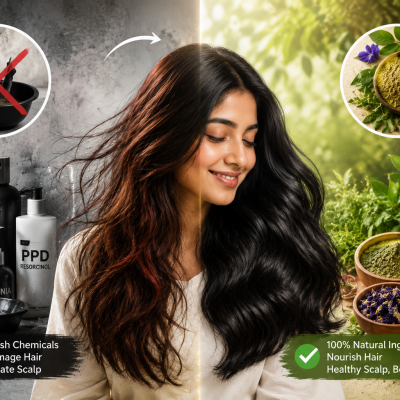
Many individuals face a persistent cycle of frustration, dealing with chronic hair fall and unmanageable dryness despite meticulous washing routines. The reality is that chemical shampoos damage hair because they prioritize immediate, superficial aesthetics over long-term scalp health.
Let's Discuss
- 1. Introduction: The Truth Behind “Clean Hair”
- 2. What Are Chemical Shampoos?
- 3. How Chemical Shampoos Damage Hair Long Term
- 4. The Science of the Scalp: pH, Microbiome, and Oil Balance
- 5. Signs Your Shampoo Is Damaging Your Hair
- 6. The Illusion: Short-Term Shine vs Long-Term Damage
- 7. A Better Alternative to Liquid Shampoos: Herbal Haircare
- 8. The Modern Herbal Solution: Convenience Meets Tradition
- 9. Conclusion: Reclaim Your Hair’s Natural Strength
- 10. References
2. What Are Chemical Shampoos?
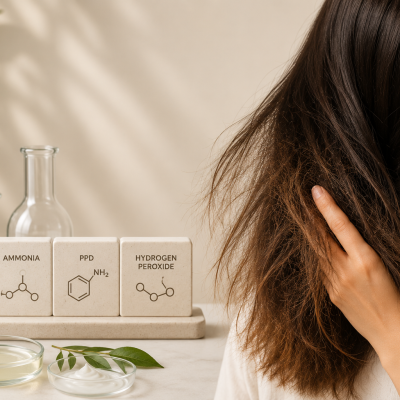
To navigate the modern hair care market effectively, a consumer must transcend the allure of glossy marketing claims and investigate the actual molecular composition of their products. Most commercial shampoos are not natural cleansers—they are synthetic, detergent-based formulations.
They are designed for:
- High foam (visual satisfaction)
- Long shelf life
- Instant smoothness
But often at the cost of your hair’s natural protein structure.
Commercial hair care relies on several high-impact chemical groups to achieve its results:
- Sulfates (SLS & SLES)
- Create foam
- Strip natural oils
- Cause protein damage
- Parabens
- Used as preservatives
- Can disrupt scalp balance leading to low grade inflammation
- Linked to long-term sensitivity
- Silicones (e.g., Dimethicone)
- Provide artificial shine
- Coat the hair shaft
- Block moisture absorption
👉 While these ingredients fulfil commercial needs like preservation and high-foam aesthetics, emerging research suggests that repeated exposure to surfactants and preservatives can gradually alter the scalp’s natural balance and microbiome over time (Wang et al., 2025; Clavaud et al., 2013).
Join the Journey Back to Natural Hair Care
We are building more than just products—we are building a community
that believes in thoughtful, effective, and responsible hair care.
3. How Chemical Shampoos Damage Hair Long Term
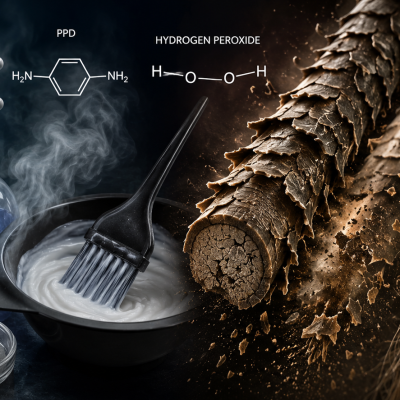
The damage inflicted by synthetic hair care is rarely a sudden event; it is a cumulative process of attrition. Because these products are marketed for “everyday use,” the scalp and follicle are subjected to a persistent state of chemical stress. Over months and years, the harmful effects of shampoo manifest as a breakdown in the hair’s structural and protective systems.
1. Stripping Natural Oils
Sulfates remove not just dirt—but also your scalp’s natural oils. This leads to:
- Dry, brittle hair
- Increased hair porosity
- Weak strands
2. Weakening Hair Roots
The health of a hair strand is entirely dependent on the health of the follicle. Constant exposure to synthetic fragrances and harsh preservatives can trigger a chronic inflammatory response in the dermal papilla which can:
- Irritate the scalp
- Cause inflammation
- Weaken hair follicles
👉 Result: Increased hair fall
3. Disrupting the Scalp Microbiome
The scalp is home to a complex microbiome that plays a critical role in maintaining skin health and immunity. Studies have shown that different shampoo formulations can significantly alter the composition of this microbiome, potentially leading to imbalance, irritation, and conditions like dandruff (Clavaud et al., 2013; Wang et al., 2025).
Chemical preservatives like parabens:
- Kill both good & bad bacteria
- Disrupt scalp health
- Lead to dandruff and irritation
4. The Oiliness Cycle (Sebum Imbalance)
Studies have shown that frequent use of strong cleansing agents can strip the scalp of its natural oils, triggering a compensatory increase in sebum production. This cycle of over-cleansing and overproduction can lead to persistent oiliness and scalp imbalance over time (Dawson, 2007). When your scalp loses oil, it overcompensates.
This creates a loop:
👉 Wash → Dry scalp → More oil → Wash again
👉 This is why hair becomes oily quickly after shampooing.
👉 Synthetic hair care causes gradual, long-term damage by stripping natural oils, weakening follicles, disrupting the scalp microbiome, and triggering an imbalance that leads to dryness, irritation, hair fall, and recurring oiliness.
4. The Science of the Scalp: pH, Microbiome, and Oil Balance
The scalp maintains a slightly acidic pH (~5.5), which is essential for barrier function and cuticle integrity. Disruption of this balance through harsh cleansing agents can impair the skin barrier and contribute to dryness, irritation, and hair damage (Lambers et al., 2006).
Many shampoos:
- Disrupt this balance
- Open hair cuticles
- Cause frizz and breakage
👉 Over time, your hair loses its natural shine and strength. The result is a total loss of the hair’s “self-cleaning” and “self-moisturizing” capabilities, leading to the chronic issues consumers spend hundreds of dollars trying to fix with yet more chemicals.
5. Signs Your Shampoo Is Damaging Your Hair
If you notice these, your shampoo may be the culprit:
-
- Excessive hair fall during washing – It may be a sign of follicular inflammation. The chemicals are literally stressing the root, causing the hair to enter the telogen (shedding) phase prematurely.
- Itchy or irritated scalp – Because these products are liquid-based, they require high concentrations of biocides to remain shelf-stable, which can be highly irritating to sensitive dermal layers.
- “Squeaky clean” feeling after wash – It means the hair has been stripped of its natural lubrication, leading to friction-induced damage.
- Oily scalp + dry ends – The scalp is overcompensating for the damage done to the hair lengths, creating a “combination” profile that is a direct result of chemical imbalance.
👉 These are not normal—they are signals of chemical stress.
6. The Illusion: Short-Term Shine vs Long-Term Damage
The commercial hair care industry thrives on a specific marketing tactic: using “aesthetic fixes” to mask “structural damage.” Ingredients such as silicones can form a coating over the hair shaft, creating the appearance of smoothness and shine(Robbins, 2012).:
But this comes at a cost:
- Hair gets coated (like plastic)
- Prevents atmospheric moisture and genuine nutrients from penetrating the hair shaft.
- Hair becomes dry and brittle internally
7. A Better Alternative to Liquid Shampoos: Herbal Haircare
In response to the chemical crisis, a movement toward “functional cleansing” has emerged. This philosophy, championed by Fusion of Herbs and its founder, Akanksha Sharma, asks a vital question: Why does effective hair care have to be harsh or complicated? By bridging traditional Indian wisdom with modern standards, we can achieve a clean that respects the scalp’s biology.
The “Fusion of Herbs” approach utilizes traditional powders that are inherently Fragrance-Free, Preservative-Free, and Sulfate-Free.
Key herbal ingredients provide a comprehensive hair-care solution without the “pH shock” of liquid detergents.:
- Amla & Reetha: These provide a gentle, saponin-based cleanse. Amla is rich in Vitamin C and antioxidants that strengthen the hair fibre, while Reetha creates a soft, natural foam that cleanses without stripping the acid mantle
- Shikakai: Functioning as a natural, low-pH cleanser, Shikakai ensures the hair cuticle remains closed, naturally detangling the hair while removing excess oil.
- Neem & Aloevera: These provide soothing, anti-bacterial protection. Neem addresses scalp irritation and dandruff, while Aloevera acts as a natural humectant, drawing moisture into the scalp without using silicones.
Methidana & Curry Leaves: Crucial for root health, Methidana (Fenugreek) is high in protein and nicotinic acid, which are known to combat hair fall, while Curry Leaves provide essential nutrients that support the hair’s natural pigmentation and strength.
8. The Modern Herbal Solution: Convenience Meets Tradition
Fusion of Herbs has modernized this traditional process with a minimal, conscious, and travel-friendly
Shampoo Like Experience:
- Mix: Combine the herbal powder with water in a bottle or shaker.
- Shake: Agitate the mixture until it forms a smooth, consistent thick liquid.
- Apply: Pour the mixture directly onto the scalp, massage into the roots, and rinse.
👉 No soaking. No boiling. No mess.
9. Conclusion: Reclaim Your Hair’s Natural Strength
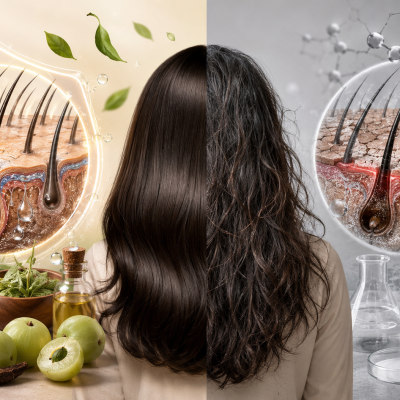
The hidden cost of commercial hair care is the slow erosion of our hair’s natural resilience. The long-term risks of chemical shampoos—from microbiome disruption to structural weakening—far outweigh the temporary, aesthetic convenience of a foamy liquid wash. True hair health requires us to respect tradition and biological reality, focusing on a cleaner, more responsible way to care for ourselves.
By choosing a smarter, herbal alternative like Fusion of Herbs, you are moving away from the “plastic-wrap” illusions of the industry and toward sustainable, deep nourishment. It is time to rediscover the power of ingredients your hair actually understands.
Join the Journey Back to Natural Hair Care Be part of a community that believes in thoughtful, effective, and responsible hair care. Reclaim your hair’s natural strength and clarity today.
10. References:
- Clavaud, C., Jourdain, R., Bar-Hen, A., Tichit, M., Bouchier, C., Pouradier, F., El Rawadi, C., Guillot, J., Ménard-Szczebara, F., Breton, L. and Latgé, J.P. (2013) ‘Dandruff is associated with disequilibrium in the proportion of the major bacterial and fungal populations colonizing the scalp’, PLoS ONE, 8(3), e58203.
- Dawson, T.L. (2007) ‘Malassezia globosa and restricta: Breakthrough understanding of the etiology and treatment of dandruff and seborrheic dermatitis through whole-genome analysis’, Journal of Investigative Dermatology Symposium Proceedings, 12(2), pp. 15–19.
- Lambers, H., Piessens, S., Bloem, A., Pronk, H. and Finkel, P. (2006) ‘Natural skin surface pH is on average below 5, which is beneficial for its resident flora’, International Journal of Cosmetic Science, 28(5), pp. 359–370.
- Robbins, C.R. (2012) Chemical and Physical Behavior of Human Hair. 5th edn. Berlin: Springer.
- Wang, L., Li, Y., Zhang, J. and Xu, Z. (2025) ‘High-throughput sequencing reveals changes in the human scalp microbiome during shampoo use’, BMC Microbiology.