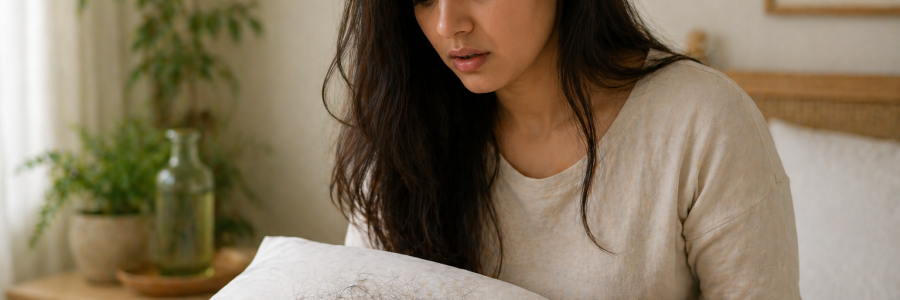
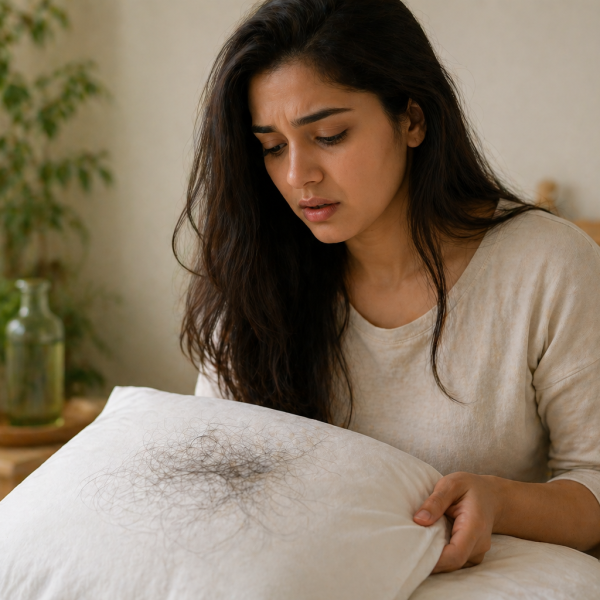
Persistent hair fall can feel deeply frustrating—especially when you’re doing everything you believe is right. You switch shampoos, try oils, follow routines, and maybe even invest in treatments. Yet, the shedding continues.
At this stage, the issue is rarely a lack of effort. It’s usually a misalignment between what your hair needs and what you’re doing. Hair doesn’t respond to intensity—it responds to balance, consistency, and the right environment (Draelos, 2010).
Let's Discuss
1. The Frustration Cycle: Why “Doing More” Backfires
When hair fall increases, most people react by doing more:
- Washing more frequently
- Trying stronger products
- Adding multiple treatments
This creates a loop:
Hair fall → Panic → More products → Temporary relief → Hair fall returns
This cycle not only drains your energy but also overwhelms your scalp, making recovery harder. Excessive cosmetic intervention has been shown to disrupt normal scalp function rather than restore it (Trüeb, 2007).
The key shift:
👉 Stop asking “What more can I do?”
👉 Start asking “What is disrupting my hair’s natural balance?”
2. The Real Problem: Surface Fixes vs Root Causes
Many solutions today focus on appearance, not health.
Shiny, smooth hair is often created through coatings—not real strength. These temporary fixes:
- Mask underlying issues
- Create buildup
- Prevent your scalp from functioning naturally
When you treat symptoms instead of causes, hair fall becomes a recurring problem—not a solved one. Cosmetic formulations are often designed for immediate sensory results rather than long-term scalp health (Draelos, 2010). Read More.
👉 Hair fall persists when solutions target appearance instead of scalp biology — long-term results come only from correcting underlying imbalances (Draelos, 2010).
Join the Journey Back to Natural Hair Care
We are building more than just products—we are building a community
that believes in thoughtful, effective, and responsible hair care.
3. 7 Common Mistakes That Make Hair Fall Worse
Often, it’s not what you’re missing—it’s what you’re unknowingly doing wrong.
- Over-Washing to Control Hair Fall
Frequent washing strips your scalp’s natural barrier, leading to irritation and imbalance. A stressed scalp often sheds more—not less (American Academy of Dermatology).
For women in the 30–50 age bracket, whose scalps already face hormonal shifts, this instability compromises the scalp’s ability to support robust hair retention. A disrupted barrier is directly linked to inflammation-driven shedding (Experimental Dermatology).
- Relying on “Squeaky Clean” Shampoos
Heavy lather and strong cleansing may feel satisfying, but they often disrupt the scalp’s natural ecosystem. Sulfate-based surfactants are known to impair barrier function and increase irritation (Journal of Cosmetic Dermatology).
Choosing “clean-looking” products that are biologically harsh is a primary driver of preventable, long-term shedding.
- Constantly Switching Products
Changing products every few weeks prevents your scalp from adapting. Hair care needs time—not constant experimentation.
Frequent formulation changes can disrupt the scalp microbiome and delay stabilization (Experimental Dermatology). This creates “biological confusion,” where the scalp never reaches equilibrium.
- Ignoring Scalp Health
Focusing only on hair length while neglecting the scalp weakens the foundation where hair actually grows.
The scalp functions as a biological ecosystem, and imbalance at this level directly affects follicle performance (Skin Microbiome Research, Experimental Dermatology).
- Layering Too Many Styling Products
Multiple leave-ins and styling products create buildup, which blocks follicles and affects hair quality over time. Residue accumulation has been linked to scalp dysfunction and reduced hair shaft quality (Trüeb, 2007).
For women over 30, this persistent buildup can contribute to follicle miniaturization.
- Handling Wet Hair Aggressively
Hair is most fragile when wet. Rough towel drying or brushing leads to breakage that often looks like hair fall.
Studies show that wet hair has significantly reduced tensile strength, making it more prone to mechanical damage (Journal of Investigative Dermatology).
- Heat Styling
Heat doesn’t just style your hair—it gradually weakens the protein structure of the hair fiber. Repeated thermal exposure damages keratin and cuticle layers, leading to breakage (Robbins, Chemical and Physical Behavior of Human Hair).
What looks like hair fall is often hair breaking before it has a chance to grow strong.
👉 Most persistent hair fall is self-inflicted through over-treatment, harsh cleansing, and routine inconsistency that disrupts the scalp ecosystem (Experimental Dermatology; Trüeb, 2007).
4. The Deeper Reasons Your Hair Fall Isn’t Stopping
When we aggregate these mistakes, a clear pattern emerges: modern routines are often too aggressive, too crowded, and too impatient.
If you find yourself constantly asking “why my hair fall is getting worse,” your routine—not your genetics—is likely the culprit.
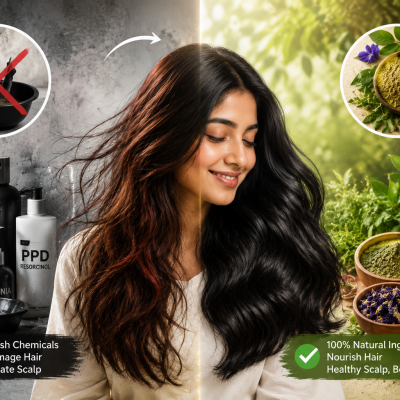
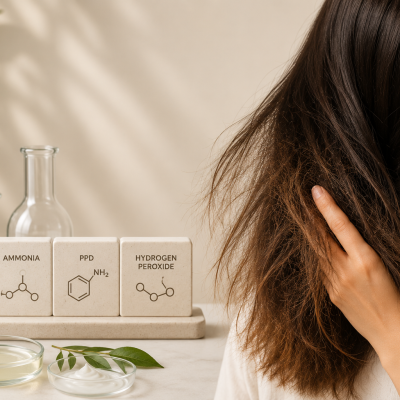
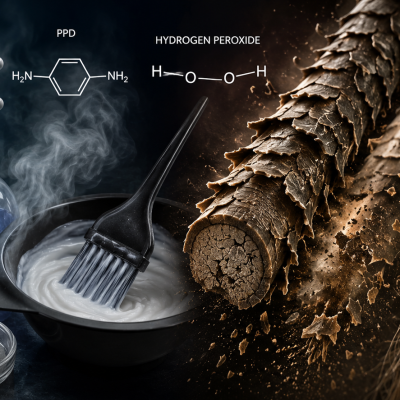
- Scalp Imbalance Due to Harsh Chemicals
Harsh cleansing followed by product buildup creates a cycle of dryness and oiliness—neither of which supports healthy hair. Repeated disruption of the scalp barrier leads to inflammation and impaired follicle function (Journal of Cosmetic Dermatology). Read More.
- Perpetual Shock Due to Constant Product Switching
Frequent changes in routine confuse the natural hair cycle and microbiome, prolonging shedding phases (Experimental Dermatology).
- Stress & Hormonal Impact
Chronic stress increases cortisol levels, which can push hair into the resting phase, leading to delayed but persistent shedding—a condition clinically known as Telogen Effluvium (Nature Reviews Endocrinology).
Hormonal fluctuations, especially in women aged 40+, further influence hair density and growth cycles (Menopause Review).
5. What Actually Works (A Smarter Approach)
Instead of adding more, focus on doing the right things consistently.
We must move from aggressive “fixing” to biological “restoring.”
👉 Stop trying to fix your hair. Start restoring its natural balance.
Choose Gentle, Residue-Free Cleansing
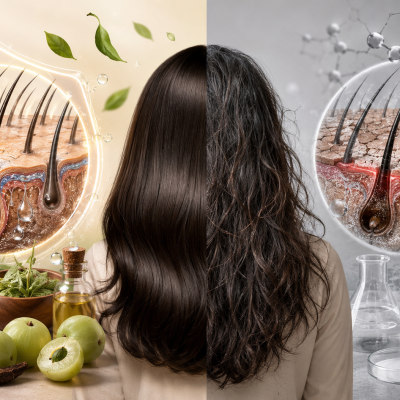
Utilize time-tested herbs such as Amla, Reetha, Shikakai, Aloe Vera, Neem, Methi dana, and Curry Leaves.
Research in ethnopharmacology and phytotherapy highlights the antioxidant, antimicrobial, and scalp-supportive properties of these botanicals (Journal of Ethnopharmacology; Phytotherapy Research).
A powder-based herbal approach avoids synthetic stabilizers and preservatives, reducing long-term scalp stress while maintaining natural balance. Read More.
6. Conclusion
Persistent hair fall is rarely just a surface issue—it is often a signal from your body, urging a shift from reactive care to restorative care.
For women in their 30s, 40s, and 50s, hair fall is influenced by hormonal changes, stress, and accumulated lifestyle habits. Long-term exposure to harsh formulations can also reduce the scalp’s resilience over time (Nature Reviews Endocrinology , Menopause Review).
At this stage, the focus should not be on doing more—but on doing things differently.
Returning to a clean, simple, and effective hair care ritual can make a meaningful difference. Reducing unnecessary additives like preservatives and artificial fragrances lowers the cumulative stress on the scalp. Read More.
🌿 A Simpler Path Forward
True progress begins with a shift in mindset:
• From panic → awareness
• From overdoing → simplifying
• From fixing → restoring
Because sometimes, the most powerful solution isn’t adding something new—
it’s removing what has been quietly holding your hair back all along.
7. References:
- Draelos, Z.D. (2010) ‘Hair cosmetics: An overview’, International Journal of Trichology, 2(2), pp. 42–46.
- Trüeb, R.M. (2007) ‘Shampoos: Ingredients, efficacy and adverse effects’, Journal of the German Society of Dermatology, 5(5), pp. 356–365. Available at: https://pubmed.ncbi.nlm.nih.gov/17451380/
- American Academy of Dermatology (n.d.) ‘Hair habits that damage your hair’. Available at: https://www.aad.org/public/everyday-care/hair-scalp-care/hair/habits-that-damage-hair
- Journal of Cosmetic Dermatology (n.d.) ‘Effects of surfactants and cosmetic formulations on scalp health’. Available at: https://www.sciencedirect.com/science/article/abs/pii/S0927776525005338
- Experimental Dermatology (n.d.) ‘Unlocking the secrets of the hair microbiome: From scalp health to therapeutic advances’. Available at: https://www.sciencedirect.com/science/article/pii/S2950194625001219
- Journal of Investigative Dermatology (n.d.) ‘Mechanical properties and tensile strength of human hair fibers’. Available at: https://pubmed.ncbi.nlm.nih.gov/28183593/
- Robbins, C.R. (2012) Chemical and physical behavior of human hair. 5th edn. Springer. Available at: https://link.springer.com/book/10.1007/978-3-642-25611-0
- Nature Reviews Endocrinology (n.d.) ‘Hormonal regulation of hair growth and stress-related hair loss’. Available at: https://pmc.ncbi.nlm.nih.gov/articles/PMC9788837/
- Menopause Review (n.d.) ‘Hair loss in women’. Available at: https://my.clevelandclinic.org/health/diseases/16921-hair-loss-in-women
- Journal of Ethnopharmacology (n.d.) ‘Ethnopharmacology and hair: Indian perspectives’. Available at: https://www.academia.edu/127508464/Ethnopharmacology_and_hair_Indian_perspectives
- Phytotherapy Research (n.d.) ‘Plant-based compounds and their role in hair growth and scalp care’. Available at: https://pmc.ncbi.nlm.nih.gov/articles/PMC9963650/