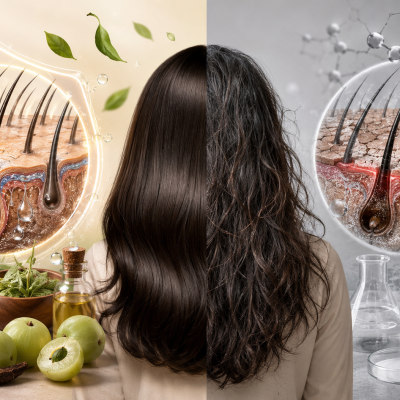
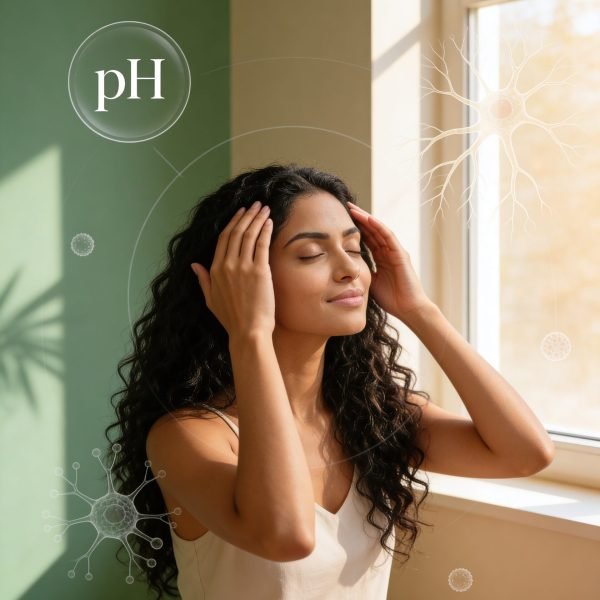
Most commercial hair care products follow a “strip and coat” approach—shampoos remove natural oils aggressively, and conditioners or serums add a temporary smooth coating instead of nourishing the hair with Natural Ingredients. This leads to a cycle where the scalp becomes dry and starts producing more oil, while the hair lengths become even drier and weaker (Cowley & Farr, 1992; Teo, 2020).
Instead of trying to control the oil with stronger products, the real solution lies in understanding the cause. When you focus on gentle cleansing, maintaining the right pH, avoiding buildup, and supporting your scalp’s natural function with Natural Ingredients, your hair gradually begins to recover. In simple terms, an oily scalp with dry hair is a sign of imbalance, and with the right care, it can be corrected over time.
Let's Discuss
1. How Natural Ingredients Help Restore Hair Balance
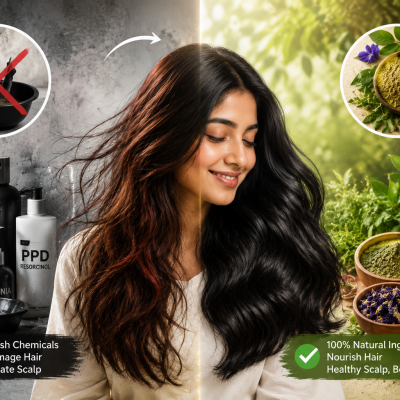
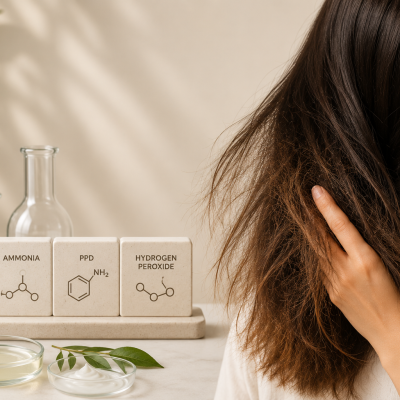
The problem of an oily scalp and dry hair is mostly caused by damage from harsh chemicals, product buildup, and natural hormonal changes (Wagh et al., 2024). To fix this, instead of using strong products that only control symptoms, a better approach is to switch to gentle, plant-based care (Wagh et al., 2024).
Scientific research shows that natural ingredients (phytochemicals) from plants can help restore balance in a safer and more effective way. They can regulate oil production on the scalp, protect hair from damage, and repair the outer layer of the hair (Dias, 2015; Wagh et al., 2024).
In simple terms, using the right combination of natural herbs helps treat the root cause of the problem—supporting both scalp health and hair strength—rather than just giving temporary results.
Natural ingredients which are waterless, powder-based cleansers don’t contain water, hence they don’t need preservatives or heavy additives (Chew et al., 2023). This means they are gentler, leave no buildup, and deliver fresh natural ingredients directly when mixed with water during use. As a result, they help keep the scalp clean, balanced, and healthy without blocking the hair roots (Trueb et al., 2018; Chew et al., 2023). Read More.
a. Gentle Natural Cleansing with Reetha & Shikakai
To fix oily scalp and dry hair, the first step is using a cleanser that removes excess oil without damaging the scalp (Wagh et al., 2024). Reetha (Sapindus mukorossi) is a natural ingredient that does this very effectively (Wagh et al., 2024). These help clean dirt, oil, and buildup without harming the scalp or stripping away essential moisture (Brooks et al., 2024; Ahmad et al., 2019). Unlike harsh shampoos, they do not damage hair proteins or trigger excess oil production (Ahmad et al., 2019).
When combined with Shikakai (Acacia concinna), the benefits increase further (Ahmad et al., 2019). Shikakai naturally has a mild acidic pH, which helps restore the scalp’s natural balance and helps smooth the hair cuticle, reducing dryness and frizz while improving shine and moisture retention (Khurana et al., 2022).
Together, these herbs gently cleanse, maintain scalp balance, and improve hair texture—without causing buildup or damage.
b. Curry Leaves for Hair Strength and Scalp Health
Murraya koenigii (Curry leaves) is a powerful natural ingredient known for improving scalp health, controlling excess oil, and strengthening hair (Trueb et al., 2018; Cowley & Farr, 1992; Teo, 2020). It contains beneficial plant compounds like linalool, elemol, and geranyl acetate, which help protect the scalp and hair (Chew et al., 2023).
Research also shows that curry leaf extracts can stimulate dermal papilla cells, which are responsible for hair growth (Dias, 2015; Wagh et al., 2024). This helps make hair stronger, thicker, and more resistant to breakage, especially during hormonal changes (Cowley & Farr, 1992; Chew et al., 2023).
c. Fenugreek for Deep Moisture and Hair Strength
Trigonella foenum-graecum (Fenugreek or Methidana) is a powerful natural ingredient that helps repair dry hair without making the scalp oily (Trueb et al., 2018; Wagh et al., 2024). It is rich in proteins, iron, zinc, and healthy fatty acids, which nourish the hair and improve its strength (Wagh et al., 2024).
When fenugreek is mixed with water, it releases a natural gel-like substance called mucilage (Wagh et al., 2024). This acts like a light, natural conditioner that coats damaged hair strands, especially dry and porous areas (Dias, 2015; Wagh et al., 2024). It helps reduce friction, lock in moisture, and improve softness and elasticity—without the heaviness or buildup caused by synthetic conditioners (Wagh et al., 2024).
Fenugreek can reduce the effect of DHT, a hormone linked to hair thinning and weakening (Wagh et al., 2024). This helps maintain hair thickness, strength, and overall health, especially in women experiencing age-related hair changes (Wagh et al., 2024).
In simple terms, fenugreek provides lightweight hydration, repairs damage, and supports stronger, healthier hair from within.
d. Neem and Amla for Scalp Health and Hair Growth
Azadirachta indica (Neem) and Emblica officinalis (Amla) are two powerful natural ingredients that help control scalp problems and support healthy hair growth (Cowley & Farr, 1992; Brooks et al., 2024). Neem is especially useful for reducing scalp inflammation and controlling excess oil caused by microbial imbalance (Brooks et al., 2024; Ahmad et al., 2019). It contains active compounds like nimbidin and azadirachtin, which help calm irritation, reduce itching, and manage conditions like dandruff and scalp sensitivity (Ahmad et al., 2019). Neem also has strong antifungal and antibacterial properties, helping fight organisms like Malassezia furfur that contribute to dandruff and oil imbalance (Brooks et al., 2024; Ahmad et al., 2019). By controlling these microbes, neem helps restore scalp balance and reduce excess oil production (Brooks et al., 2024).
Amla, on the other hand, works by strengthening the hair and protecting it from damage (Khurana et al., 2022). It is rich in Vitamin C and antioxidants, which help reduce damage caused by pollution and oxidative stress (Khurana et al., 2022). It also supports the activity of dermal papilla cells, which are responsible for hair growth, improving hair strength and thickness over time (Trueb et al., 2018; Cowley & Farr, 1992; Teo, 2020).
Together, neem and amla help keep the scalp clean and balanced, reduce inflammation, and support stronger, healthier hair growth naturally.
2. Simple Routine to Restore Scalp and Hair Balance
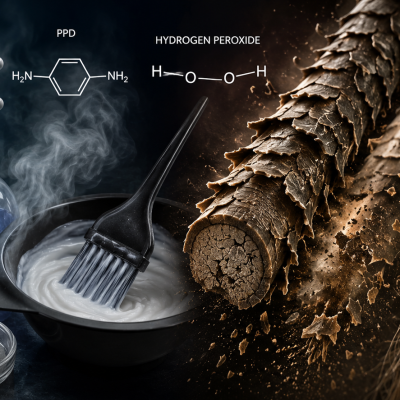
Research shows that common hair care methods—like frequent washing with strong shampoos and using heavy conditioners—don’t actually fix the problem of oily scalp and dry hair. In fact, they often make it worse. Harsh shampoos damage the hair’s protective layer and force the scalp to produce more oil, while silicones and heavy products build up on the scalp, blocking pores and trapping dirt and oil (Chew et al., 2023).
To truly improve hair health, a different and more natural approach is needed. This means switching to a simple, residue-free routine using herbal powders instead of chemical-based liquid products (Chew et al., 2023; Khanpara et al., 2012; Jawale et al., 2025; George & Shanmugam, 2014).
.
👉 Fusion of Herbs combines all these beautiful herbs in a well-balanced format. Freshly mixing it with water before use (Mix-Shake-Apply method) avoids the need for preservatives and reduces scalp irritation (Trueb et al., 2018; Wagh et al., 2024)
Join the Journey Back to Natural Hair Care
We are building more than just products—we are building a community
that believes in thoughtful, effective, and responsible hair care.
3. What to expect when you switch to herbal cleansing
In the beginning, your scalp may take some time to adjust as it slowly reduces excess oil production (Dias, 2015; Wagh et al., 2024).
Transformation Phase | Key stages of scalp recovery and balance | What to expect |
Phase 1: Days 1–7 | Silicone buildup is cleaned off, and the scalp stops losing moisture caused by sulfates. (Trueb et al., 2018; Cowley & Farr, 1992). | You’ll notice a fresh, breathable scalp—no sticky or heavy residue. |
Phase 2: Weeks 2–4 | Oiliness starts to balance, your scalp’s natural pH is restored, and dandruff-causing microbes are kept under control. (Trueb et al., 2018; Cowley & Farr, 1992). | Your scalp controls oil better, so your hair stays fresh and clean for longer between washes. |
Phase 3: Month 2+ | The hair surface smooths out, moisture is locked in, and the roots are supported for healthier growth. (Trueb et al., 2018; Cowley & Farr, 1992). | Your hair regains its natural strength, becoming softer, smoother, and more resilient. |
👉 With regular use, this routine helps reset your scalp, reduce excess oil, repair damaged hair, and restore natural balance over time.
4. Conclusion
In essence, the problem of an oily scalp and dry hair is not a lack of products—but a lack of balance. Most conventional routines disrupt this balance through harsh cleansing and heavy buildup, creating a cycle that weakens both the scalp and hair over time.
By shifting to a gentle, natural approach—focused on mild cleansing, pH balance, and nourishment through plant-based ingredients—you allow your scalp to regulate itself and your hair to regain its strength naturally. Read More.
With consistency, this simple yet effective routine helps restore harmony at the root level, leading to healthier, stronger, and more resilient hair—without dependence on temporary fixes.
5. References
- Ahmad, S., Maqbool, A., Srivastava, A. & Gogol, S. (2019) ‘Biological detail and therapeutic effect of azadirachta indica (neem tree) products-a review’, Journal of Evidence-Based Medicine and Healthcare, 6(22), pp. 1607-1612. Available at: https://www.researchgate.net/publication/333843610_BIOLOGICAL_DETAIL_AND_THERAPEUTIC_EFFECT_OF_AZADIRACHTA_INDICA_NEEM_TREE_PRODUCTS-A_REVIEW.
- Brooks, S. G., Mahmoud, R. H., Lin, R. R., Fluhr, J. W. & Yosipovitch, G. (2024) ‘The Skin Acid Mantle: An Update on Skin pH’, Journal of Investigative Dermatology. Available at: https://pubmed.ncbi.nlm.nih.gov/39243251/.
- Chew, Y. L. et al. (2023) ‘Hair shampoos containing botanical ingredients without synthetic additives’, International Journal of Trichology. Available at: https://pmc.ncbi.nlm.nih.gov/articles/PMC10685248/.
- Cowley, N. C. & Farr, P. M. (1992) ‘A dose-response study of irritant reactions to sodium lauryl sulphate in patients with seborrhoeic dermatitis’, Acta Dermato-Venereologica, 72(6), pp. 432-435. Available at: https://pubmed.ncbi.nlm.nih.gov/1362835/.
- Dias, M. F. R. G. (2015) ‘Hair cosmetics: An overview’, International Journal of Trichology, 7(1), pp. 2–15. Available at: https://pmc.ncbi.nlm.nih.gov/articles/PMC4387693/.
- George, B. & Shanmugam, S. (2014) ‘Phytochemical screening and antimicrobial activity of fruit extract of Sapindus mukorossi’, International Journal of Current Microbiology and Applied Sciences, 3(10), pp. 604-611. Available at: https://www.ijcmas.com/vol-3-10/Bibi%20George%20and%20S.Shanmugam.pdf.
- Jawale, A. A., Dhanapune, P. S. & Wani, N. M. (2025) ‘Murraya koenigii, Curry leaf, Hair growth’, International Journal For Multidisciplinary Research, 7(2). Available at: https://www.ijfmr.com/research-paper.php?id=39570.
- Khanpara, K., Renuka, Shukla, V. J. & Harisha, C. R. (2012) ‘A detailed investigation on shikakai (Acacia concinna Linn.) – fruit’, Journal of Current Pharmaceutical Research, 9(1), pp. 06-10. Available at: https://www.researchgate.net/publication/280313608_A_detailed_investigation_on_shikakai_Acacia_concinna_Linn_fruit.
- Khurana, S. K., Tiwari, R., Sharun, K. & Mohd, I. (2022) ‘Emblica officinalis (Amla) with a particular focus on its antimicrobial potentials: a review’, Microbiology Journal. Available at: https://microbiologyjournal.org/emblica-officinalis-amla-with-a-particular-focus-on-its-antimicrobial-potentials-a-review/.
- Teo, W. L. (2020) ‘Diagnostic and management considerations for maskne in the era of COVID-19’, Journal of the American Academy of Dermatology, 83(4). Available at: https://twlskin.com/research-publications/.
- Trueb, R. M., Henry, J. P., Davis, M. G. & Schwartz, J. R. (2018) ‘Scalp condition impacts hair growth and retention via oxidative stress’, International Journal of Trichology, 10(6), pp. 262-270. Available at: https://pubmed.ncbi.nlm.nih.gov/30783333/.
- Wagh, P., Phonawane, S. & Karpe, P. (2024) ‘An Overview of the Fenugreek (Trigonella Foenum-Graecum) Seed Oil in Hair Care Applications’, International Journal of Pharmaceutical Sciences, 4(2). Available at: https://www.ijpsjournal.com/article/An+Overview+of+the+Fenugreek+Trigonella+Foenum+Graecum+Seed+Oil+in+Hair+Care+Applications.