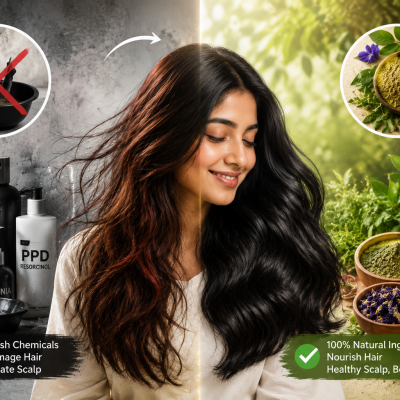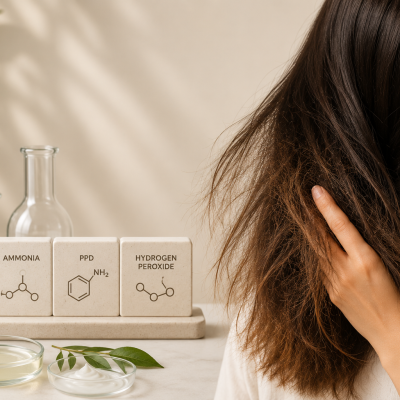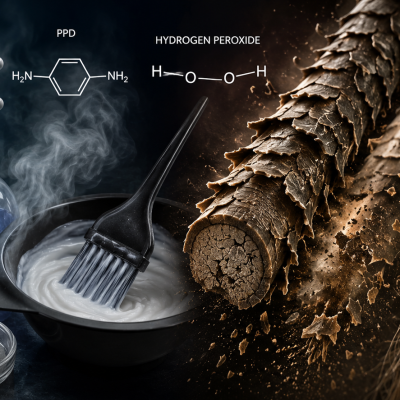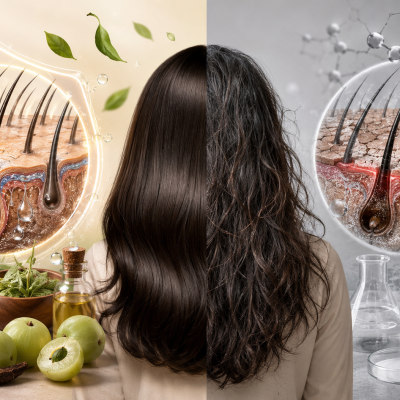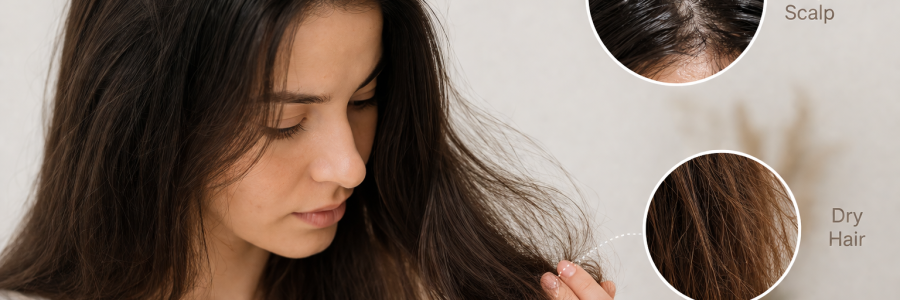
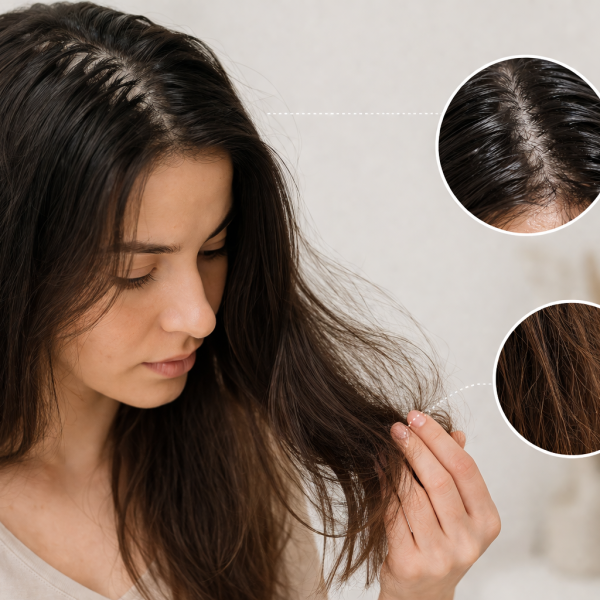
Many people struggle with a confusing problem with a quick appearance of oily scalp, but the lengths of their hair remain dry, rough, and frizzy. This is especially common in women between the ages of 30 and 50 due to natural hormonal changes along with daily factors like heat styling, pollution, and product use struggle (Brooks et al., 2024; Teo, 2020). While it may feel like the scalp and hair are behaving differently, they are actually part of the same system, and this imbalance is usually not natural but developed over time (Dias, 2015; Trueb et al., 2018).
Your scalp produces oil to protect and nourish, while your hair has a protective outer layer that helps retain moisture (Brooks et al., 2024; Cowley & Farr, 1992). However, frequent use of harsh shampoos, excessive styling, and heavy products can damage this balance.
Let's Discuss
1. Sebum Production and it’s flow down the hair
To understand why your scalp gets oily while your hair lengths stay dry, it is important to know how natural oil (sebum) works. Sebum is produced by tiny glands attached to your hair roots on the scalp. It protects your scalp, keeps it hydrated, and helps prevent infections. Ideally, this natural oil should travel down the length of your hair, coating it lightly to keep it smooth, shiny, and moisturized (Brooks et al., 2024; Chew et al., 2023).
a. How Natural Oil Moves Along Your Hair
After sebum (natural oil) is produced in the hair root, it slowly moves out of the follicle and spreads along the length of the hair. This movement happens naturally through simple forces like gravity and surface tension (Dias, 2015). As it travels, sebum forms a light coating over the hair, helping to smooth the outer layer, reduce friction, protect from environmental damage, and lock in moisture (Dias, 2015).
b. How hair type create the distribution gap
In many cases, the oil stays mostly near the roots and does not reach the ends, creating a “distribution gap” where the scalp feels oily but the lengths remain dry (Trueb et al., 2018).
Hair type plays a big role in this. In straight hair, the surface is smooth, so oil can easily move down the strands (Dias, 2015). But in wavy, curly, or kinky hair, the bends and twists block this movement. Each curve slows down the flow of oil, making it harder for sebum to reach the ends (Dias, 2015).
Because of this, people with textured hair often have dry, dehydrated ends—even if their scalp is producing enough or even excess oil (Dias, 2015).
c. How Hair Damage Blocks Natural Oil Flow
As hair gets older and goes through daily damage, its structure starts to change, especially at the ends. These ends can be 3–5 years old and are constantly exposed to heat, chemicals, and environmental stress, which makes them weak and porous (Dias, 2015). Chemical treatments like coloring, bleaching, or perming increase the hair’s pH, causing the outer protective layer (cuticle) to lift and making the hair more open and damaged (Dias, 2015).
As a result, the hair becomes more porous, meaning it has tiny gaps and spaces in its structure. This also changes how the hair surface behaves, making it more likely to absorb substances quickly (Chew et al., 2023). When natural oil (sebum) tries to move down the hair, it gets absorbed in the middle sections instead of reaching the ends. These damaged areas act like sponges, stopping the oil from traveling further (Chew et al., 2023).
Because of this, even if your scalp is producing enough oil, it never reaches the ends. This is why hair can feel oily at the roots but still remain dry, rough, and dehydrated at the tips.
2. How Harsh Shampoos Trigger Excess Oil
When trying to understand why the scalp becomes oily while hair stays dry, it’s important to look at what we use daily—especially shampoos.
a. Strip and Rebound Effect
To create a strong cleansing effect, many shampoos use chemicals like SLS and SLES (Cowley & Farr, 1992; Teo, 2020). These ingredients are very effective at removing oil, but they don’t just clean dirt—they also strip away the scalp’s natural protective oils and essential lipids (Trueb et al., 2018; Teo, 2020).
When this natural barrier is damaged, the scalp becomes dry and irritated. In response, your body tries to fix the problem by producing even more oil. This leads to a cycle where your scalp feels oily very quickly, even though it’s actually unhealthy underneath.
This creates a cycle—more oil leads to more washing, and more washing leads to even more oil production (Trueb et al., 2018; Cowley & Farr, 1992; Dias, 2015). Over time, your scalp stays oily while your hair lengths remain dry and damaged. Read More
b. Scalp’s pH alteration
The harsh Shampoos also trigger increase in scalp’s pH. This change allows Malassezia to become overactive (Ahmad et al., 2019) which starts breaking down natural scalp oils into irritating substances like fatty acids (Cowley & Farr, 1992). These irritants damage the scalp barrier, cause inflammation, and lead to dandruff, itching, and flaking (Trueb et al., 2018; Teo, 2020). In response to this irritation, the scalp produces even more oil to protect itself, which makes the problem worse (Cowley & Farr, 1992; Trueb et al., 2018). This creates a continuous cycle of oiliness, irritation, and dandruff. Read More
👉 In simple terms, harsh shampoos don’t solve oiliness—they often create it by disturbing the scalp’s natural balance.
Join the Journey Back to Natural Hair Care
We are building more than just products—we are building a community
that believes in thoughtful, effective, and responsible hair care.
3. How Harsh Shampoos Damage Hair Ends
Harsh cleansing agents don’t just affect your scalp—they also damage the ends of your hair, making them dry and brittle (Dias, 2015; Brooks et al., 2024).
a. Surfactants
These strong surfactants attach to the proteins inside your hair and penetrate beneath the outer layer (Brooks et al., 2024). This causes the hair to swell and forces the protective cuticle to lift, which increases hair porosity and makes it more vulnerable to damage (Chew et al., 2023).
With repeated use, these chemicals break down hair proteins and strip away natural moisture, reducing the hair’s strength and flexibility (Chew et al., 2023). Since hair ends cannot repair themselves, this ongoing damage makes them weak, rough, and unable to hold moisture. As a result, the ends become extremely dry, frizzy, and prone to breakage—this is what we commonly experience as “dry ends” (Chew et al., 2023).
b. Silicones Make Hair Worse Over Time
To fix dry and damaged hair, many products use ingredients like silicones and synthetic waxes (for example, dimethicone and similar compounds) (Chew et al., 2023). These ingredients make hair feel instantly smooth, shiny, and less frizzy by forming a coating over the hair surface (Chew et al., 2023).
However, this effect is only temporary. These coatings do not repair the hair—they simply hide the damage. Over time, these ingredients build up on the hair and are difficult to wash off because they are not water-soluble (Chew et al., 2023). This buildup
- Blocks moisture from entering the hair
- Can make the scalp feel heavier and oilier
- Stops natural oil from moving down the hair
- Blocks nutrients or moisture from reaching the strands (Trueb et al., 2018; Wagh et al., 2024).
As a result, while the hair may look smooth on the outside, it becomes drier and weaker from within. This worsens the problem of an oily scalp and dry hair lengths instead of fixing it (Chew et al., 2023).
c. Other ingredients in Liquid Shampoos which cause buildup
Most liquid shampoos are made with up to 80% water (Trueb et al., 2018). Because of this, they need added chemicals like preservatives, thickeners, and stabilizers to keep them from spoiling and to maintain their texture (Cowley & Farr, 1992; Trueb et al., 2018). However, these added ingredients don’t benefit your hair or scalp. Instead, they can leave behind a thin layer of residue that builds up over time and may cause irritation (Cowley & Farr, 1992; Trueb et al., 2018).
👉 This is known as the “liquid fallacy”—the idea that liquid products are necessary for cleaning, when in reality, many of their ingredients can disturb the scalp’s natural balance and increase oil production (Cowley & Farr, 1992; Teo, 2020).
4. Hormonal Changes and Hair Issues (Age 30–50)
While daily habits play a major role in causing oily scalp and dry hair, this problem is more common in women between the ages of 30 and 50 (Trueb et al., 2018; Dias, 2015). This is mainly due to natural hormonal changes in the body during perimenopause and menopause (Chew et al., 2023).
Hair growth, thickness, and oil production are all controlled by hormones (Cowley & Farr, 1992; Teo, 2020). One key hormone is estrogen, which helps keep hair healthy. It supports hair growth, improves blood flow to the scalp, and helps maintain moisture by supporting hydration and balanced oil production (Cowley & Farr, 1992; Brooks et al., 2024).
As estrogen levels start to decrease during this stage of life, these benefits are reduced. This can lead to changes like dryness, weaker hair, and imbalance in oil production, making hair more difficult to manage. At the same time, the oil glands attached to the hair follicles remain sensitive to these hormones and may produce excess oil (George & Shanmugam, 2014). This leads to an imbalance—an oily scalp but dry, fragile hair lengths (Chew et al., 2023; George & Shanmugam, 2014).
This is why harsh, oil-control shampoos often make things worse. Instead, hair at this stage needs a much gentler and more balanced approach to care.
5. Common Hair Care Mistakes (Simple Guide)
To improve an oily scalp and dry hair, it’s important to first understand and correct daily habits. Many common routines unknowingly make the problem worse by disturbing the scalp’s natural balance.
- Washing your hair too often may seem like a solution for oiliness, but it actually strips away natural oils and makes the scalp produce even more oil (Khanpara et al., 2012; Khurana et al., 2022).
- Using harsh shampoos with strong chemicals like SLS/SLES further damages the hair by weakening its structure and drying out the ends (Chew et al., 2023; Khurana et al., 2022).
- Applying heavy conditioners or silicone-based products near the scalp can clog hair roots, trap oil and dirt, and make the scalp feel greasier (Brooks et al., 2024; Chew et al., 2023).
- Excessive or heavy oiling especially leaving heavy oils on the scalp for long periods, can also clog pores and attract dirt, making it harder to clean without using harsh products (Dias, 2015; Brooks et al., 2024; Chew et al., 2023).
- Rubbing shampoo through hair lengths- At the same time, rough washing practices—like rubbing shampoo through the hair lengths—can damage already fragile ends (Mankar et al., 2021; Jawale et al., 2025).
- Using too many styling products leads to buildup, which blocks the scalp and prevents moisture from reaching the hair (Jawale et al., 2025).
- Frequently changing products also disrupts the scalp’s natural balance, not giving it enough time to recover (Jawale et al., 2025; Mankar et al., 2021).
- Excessive heat styling dries out the hair even more, causing breakage and split ends (Mankar et al., 2021; Jawale et al., 2025).
- Following generic advice for “oily” or “dry” hair doesn’t work for this mixed condition. Using the wrong type of products can either make the scalp oilier or the hair drier (Jawale et al., 2025).
In simple terms, small daily habits play a big role. Fixing these mistakes with a gentle, consistent routine is key to restoring balance and improving hair health.
6. Conclusion
The problem of having an oily scalp and dry hair is not permanent or genetic—it’s usually caused by wrong hair care habits and harsh products (Trueb et al., 2018; Cowley & Farr, 1992). When we use strong shampoos, heavy products, or disturb the natural balance of the scalp, it creates this issue over time.
The solution is simple: respect your scalp’s natural balance. Keeping the scalp pH between 4.5 and 5.5, avoiding heavy and pore-clogging products, and using gentle, plant-based ingredients can help restore health (Trueb et al., 2018; Cowley & Farr, 1992). Fusion of Herbs which contain natural compounds from herbs—like saponins, flavonoids, and other plant nutrients—help clean, repair, and protect the scalp and hair without causing damage.
When you follow a consistent and gentle routine, the scalp stops overproducing oil, and the hair starts holding moisture better. Over time, this helps bring your hair back to a healthy, balanced, and naturally strong state.
7. References:
- Ahmad, S., Maqbool, A., Srivastava, A. & Gogol, S. (2019) ‘Biological detail and therapeutic effect of azadirachta indica (neem tree) products-a review’, Journal of Evidence-Based Medicine and Healthcare, 6(22), pp. 1607-1612. Available at: https://www.researchgate.net/publication/333843610_BIOLOGICAL_DETAIL_AND_THERAPEUTIC_EFFECT_OF_AZADIRACHTA_INDICA_NEEM_TREE_PRODUCTS-A_REVIEW.
- Brooks, S. G., Mahmoud, R. H., Lin, R. R., Fluhr, J. W. & Yosipovitch, G. (2024) ‘The Skin Acid Mantle: An Update on Skin pH’, Journal of Investigative Dermatology. Available at: https://pubmed.ncbi.nlm.nih.gov/39243251/.
- Chew, Y. L. et al. (2023) ‘Hair shampoos containing botanical ingredients without synthetic additives’, International Journal of Trichology. Available at: https://pmc.ncbi.nlm.nih.gov/articles/PMC10685248/.
- Cowley, N. C. & Farr, P. M. (1992) ‘A dose-response study of irritant reactions to sodium lauryl sulphate in patients with seborrhoeic dermatitis’, Acta Dermato-Venereologica, 72(6), pp. 432-435. Available at: https://pubmed.ncbi.nlm.nih.gov/1362835/.
- Dias, M. F. R. G. (2015) ‘Hair cosmetics: An overview’, International Journal of Trichology, 7(1), pp. 2–15. Available at: https://pmc.ncbi.nlm.nih.gov/articles/PMC4387693/.
- George, B. & Shanmugam, S. (2014) ‘Phytochemical screening and antimicrobial activity of fruit extract of Sapindus mukorossi’, International Journal of Current Microbiology and Applied Sciences, 3(10), pp. 604-611. Available at: https://www.ijcmas.com/vol-3-10/Bibi%20George%20and%20S.Shanmugam.pdf.
- Jawale, A. A., Dhanapune, P. S. & Wani, N. M. (2025) ‘Murraya koenigii, Curry leaf, Hair growth’, International Journal For Multidisciplinary Research, 7(2). Available at: https://www.ijfmr.com/research-paper.php?id=39570.
- Khanpara, K., Renuka, Shukla, V. J. & Harisha, C. R. (2012) ‘A detailed investigation on shikakai (Acacia concinna Linn.) – fruit’, Journal of Current Pharmaceutical Research, 9(1), pp. 06-10. Available at: https://www.researchgate.net/publication/280313608_A_detailed_investigation_on_shikakai_Acacia_concinna_Linn_fruit.
- Khurana, S. K., Tiwari, R., Sharun, K. & Mohd, I. (2022) ‘Emblica officinalis (Amla) with a particular focus on its antimicrobial potentials: a review’, Microbiology Journal. Available at: https://microbiologyjournal.org/emblica-officinalis-amla-with-a-particular-focus-on-its-antimicrobial-potentials-a-review/.
- Mankar, S. D., Bhosale, M. S., Shelke, M. & Sonawane, P. (2021) ‘A review on Murraya koenigii: For hair growth promoter’, Research Journal of Pharmacognosy and Phytochemistry, 13(1), pp. 39-43. Available at: https://rjpponline.org/HTML_Papers/Research%20Journal%20of%20Pharmacognosy%20and%20Phytochemistry__PID__2021-13-1-7.html.
- Teo, W. L. (2020) ‘Diagnostic and management considerations for maskne in the era of COVID-19’, Journal of the American Academy of Dermatology, 83(4). Available at: https://twlskin.com/research-publications/.
- Trueb, R. M., Henry, J. P., Davis, M. G. & Schwartz, J. R. (2018) ‘Scalp condition impacts hair growth and retention via oxidative stress’, International Journal of Trichology, 10(6), pp. 262-270. Available at: https://pubmed.ncbi.nlm.nih.gov/30783333/.
- Wagh, P., Phonawane, S. & Karpe, P. (2024) ‘An Overview of the Fenugreek (Trigonella Foenum-Graecum) Seed Oil in Hair Care Applications’, International Journal of Pharmaceutical Sciences, 4(2). Available at: https://www.ijpsjournal.com/article/An+Overview+of+the+Fenugreek+Trigonella+Foenum+Graecum+Seed+Oil+in+Hair+Care+Applications