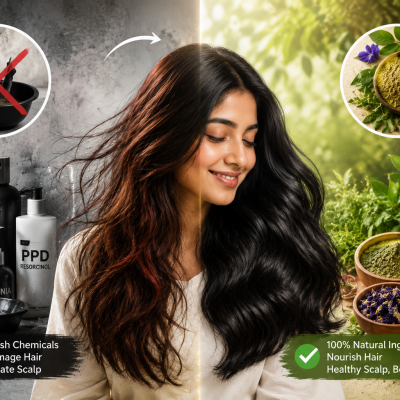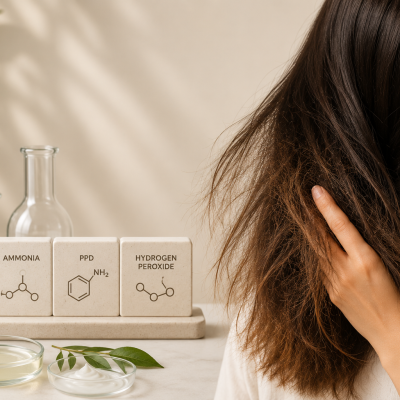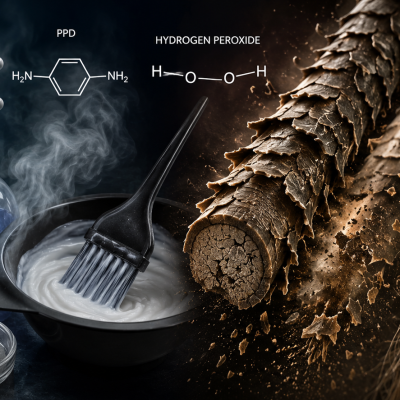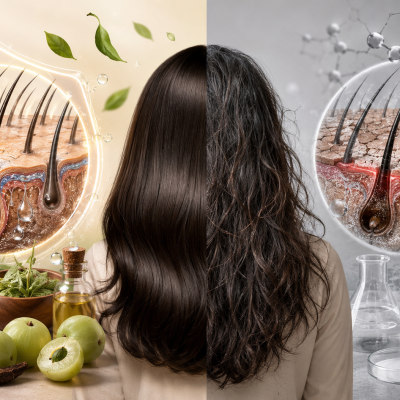

Instead of treating hair like a surface that needs quick fixes, it’s important to see it as something living that needs balance and proper care. Modern science now supports what traditional practices have long suggested—gentle, plant-based care can help restore hair health from within. By choosing simpler, natural formulations, you can reduce damage and gradually bring your hair back to a healthier, stronger, and more manageable state. Read More.
Let's Discuss
1. How Natural Herbs Help Repair and Strengthen Hair
When hair becomes damaged from chemicals, pollution, and hard water, just using conditioners isn’t enough. You need ingredients that actually repair and support your hair and scalp. This is where traditional Ayurvedic herbs work really well—they don’t just cover the problem, they help fix it from the root. Read More.
1.1 Gentle Natural Cleansing (Reetha & Shikakai)
Instead of harsh shampoos, herbs like Reetha and Shikakai clean your hair gently (Pradhan & Bhattacharyya, 2017). They contain natural cleansing agents called saponins that remove dirt and oil without stripping your hair’s natural moisture.
Because they are mild, they don’t damage the hair barrier or cause dryness and excess oil production like sulfates do (Chen et al., 2010). Shikakai also helps keep the scalp slightly acidic, which keeps hair smooth, soft, and less tangled.
1.2 Protection from Damage (Amla)
Daily exposure to sun and pollution damages hair over time. Amla helps protect your hair because it is rich in Vitamin C and antioxidants (Jang et al., 2018).
It fights damage caused by pollution, reduces hair weakening, and helps delay premature greying. It also keeps the scalp healthy and reduces inflammation (Jang et al., 2018).
1.3 Deep Repair and Moisture (Fenugreek)
Fenugreek (Methidana) is excellent for repairing dry and damaged hair. It contains natural fats and proteins that help rebuild the hair’s protective layer (Pintus et al., 2022).
It fills tiny cracks in damaged hair, making it smoother, stronger, and less frizzy. It also helps retain moisture, improving softness and manageability over time (Pintus et al., 2022).
1.4 Healthy Scalp & Hair Growth (Neem & Curry Leaves)
Healthy hair starts with a healthy scalp. Neem helps control dandruff and scalp infections by reducing harmful microbes (Mankar et al., 2021).
Curry leaves improve blood circulation to the scalp, which helps deliver nutrients to hair roots. This supports stronger hair growth, reduces hair fall, and may even delay greying (Jain et al., 2012).
In simple terms, these herbs work together to gently cleanse, repair damage, protect from pollution, and support healthy hair growth. Instead of giving temporary results, they help restore your hair’s natural strength and balance over time.
2. Why Powder-Based Hair Care Is Better
A new and smarter approach in hair care is moving from liquid shampoos to powder-based (waterless) formulations. This isn’t just about trends—it actually has strong scientific benefits.
2.1 Why Liquid Shampoos Need Chemicals
Most liquid shampoos contain 70–80% water (Dao et al., 2018). While that may seem harmless, this water creates the perfect environment for bacteria and fungi to grow.
To prevent spoilage, companies have to add chemical preservatives like parabens and alcohols (Dao et al., 2018). These chemicals don’t just protect the product—they can also:
- Disrupt your scalp’s natural microbiome
- Cause irritation or dryness
- Weaken the scalp barrier over time
So while the shampoo stays “safe” in the bottle, it may not be ideal for your scalp.
2.2 Why Powder Formulations Work Better
Powder-based hair products contain no water, which means bacteria and fungi simply cannot grow in them (Carter & Schmidt, 2012). Because of this:
- No preservatives are needed
- The formula stays clean and gentle
- It’s safer for your scalp
Another big advantage is that the natural ingredients stay fresh and powerful. In liquid products, nutrients slowly break down over time. But in powder form, they remain stable and effective until you mix them with water during use (Carter & Schmidt, 2012).
👉In simple terms, powder formulations give you:
- Gentle cleansing without harsh chemicals
- No product buildup
- Better delivery of natural nutrients
This makes them a smarter, cleaner, and more effective way to care for your hair and scalp.
Join the Journey Back to Natural Hair Care
We are building more than just products—we are building a community
that believes in thoughtful, effective, and responsible hair care.
3. Fixing Common Hair Care Mistakes (Simple Guide)
If your hair is dry, frizzy, or damaged, just switching products isn’t enough. The real change comes from fixing everyday hair care habits that silently damage your hair over time (Ruetsch et al., 2001).
Many common routines—like over-washing, using harsh shampoos, excessive heat styling, or layering too many products—put continuous stress on your hair. This leads to dryness, breakage, and frizz that keeps coming back.
To truly improve hair health, you need a simple and mindful approach:
- Be gentle with your hair
- Avoid harsh chemicals and excess heat
- Keep your routine minimal and consistent
Common Hair Care Mistake | What it does to your hair and scalp | Scientifically proven solution |
Over-washing to control frizz. | Removes natural oils from the scalp, causing it to produce excess oil, while also making the hair lengths dry, weak, and more prone to damage. | Switch to gentle, natural powder cleansers that don’t leave buildup. Wash your hair only 2–3 times a week so your scalp can maintain its natural balance. |
Aggressive Wet-Hair Management. | Hair is highly fragile when wet due to disrupted hydrogen bonds. Rough towel drying causes micro-tears in the swollen cuticle. | Reduce rough handling—gently squeeze out water with a soft towel and avoid brushing wet hair until it dries, as it is more fragile. |
Product Overload / Silicone Reliance. | Using too many heavy serums creates a thick layer on the hair that blocks moisture from getting inside, making the hair dry and weak from within. | Keep your routine simple—use light, natural oils like fenugreek or amla that absorb into the hair instead of just sitting on top. |
Frequent Product Switching. | Stops the scalp from maintaining its natural balance of good bacteria and healthy pH levels. | Stay consistent—follow a gentle herbal powder routine for at least 4–6 weeks so your scalp and hair have enough time to repair and rebalance.. |
Neglecting the Scalp “Soil”. | Focusing only on the hair lengths ignores the roots, where hair actually grows. If the scalp stays inflamed, new hair will continue to grow weak and unhealthy. | Focus on the roots—use natural ingredients like neem and curry leaves that keep the scalp healthy, reduce inflammation, and support better hair growth. |
👉 When you correct these small but important habits, your hair slowly becomes stronger, smoother, and easier to manage over time (Ruetsch et al., 2001).
4. What to Expect When You Switch to Natural Hair Care
If you’re used to instant results from chemical-based products, switching to natural hair care may feel different at first. Real hair repair takes time—it’s a gradual process where your scalp and hair slowly heal and regain their natural balance.
- Weeks 1–2: Detox Phase
As product buildup starts to wash away, your hair may feel different than usual. It might feel lighter or less “coated,” but your scalp will feel cleaner, fresher, and more comfortable (Cheng et al., 2020). - Weeks 3–4: Rebalancing Phase
Your scalp begins to settle. Oil production becomes more balanced, and your scalp’s natural protective layer improves. You may start noticing healthier shine and more even moisture from roots to ends. - Month 2 and Beyond: Repair Phase
With consistent care, your hair becomes stronger, smoother, and easier to manage. Frizz reduces naturally, and your hair starts holding moisture better. Over time, it looks healthier because it actually is healthier from within (Pintus et al., 2022; Tokunaga et al., 2019).
In simple terms, natural hair care doesn’t give instant results—but it gives real, long-lasting results if you stay consistent. Read More.
5. Conclusion
Restoring dry and frizzy hair requires moving away from harsh, chemical-heavy routines and adopting gentler, more natural alternatives. Simple changes—like mild cleansing, maintaining the right pH, reducing heat damage, and focusing on scalp health—can gradually bring hair back to a healthier state.
Fusion of Herbs makes this process even more powerful. Instead of depending on one ingredient, combining herbs like Reetha and Shikakai for gentle cleansing, Amla for protection, Fenugreek for deep repair, and Neem and Curry leaves for scalp health creates a complete care system. These ingredients work together in synergy—cleansing without stripping, nourishing without buildup, and supporting both the hair and scalp at the same time.
With consistent use, this natural, herb-based approach helps restore moisture balance, strengthen the hair structure, reduce frizz, and improve overall manageability. In the long run, it offers not just temporary smoothness, but real, lasting hair health.
6. References
- Pradhan, A. and Bhattacharyya, A., 2017. Saponins from plant species as alternative surfactants. Journal of Surfactants and Detergents, 20(3), pp.527–536.
Available at: https://link.springer.com/article/10.1007/s11743-017-1948-2 - Chen, Y.F., Yang, C.H., Chang, M.S., Ciou, Y.P. and Huang, Y.C., 2010. Foam properties and detergent abilities of the saponins from Camellia oleifera. International Journal of Molecular Sciences, 11(11), pp.4417–4425.
Available at: https://www.mdpi.com/1422-0067/11/11/4417 - Jang, S.H., Kim, M.J., Wee, J.H., Kim, J.T. and Choi, W.H., 2018. Hair growth-promoting effect of Phyllanthus emblica. Korean Society for Biotechnology and Bioengineering Journal, 33(4), pp.299–305.
Available at: https://koreascience.kr/article/JAKO201810648288060.page - Pintus, F., Spanò, D., Corona, A. and Medda, R., 2022. Fenugreek (Trigonella foenum-graecum L.) as a valuable medicinal plant. Plants, 11(11), p.1426.
Available at: https://www.mdpi.com/2223-7747/11/11/1426 - Mankar, S.D., Bhosale, M.S., Shelke, M. and Sonawane, P., 2021. A review on Murraya koenigii for hair growth promoter. Research Journal of Pharmacognosy and Phytochemistry, 13(1), pp.39–43.
Available at: https://rjpponline.org/AbstractView.aspx?PID=2021-13-1-8 - Jain, V., Momin, M. and Laddha, K., 2012. Murraya koenigii: An updated review. International Journal of Ayurvedic and Herbal Medicine, 2(4), pp.607–627.
Available at: https://interscience.org.uk/v2-i4/7%20ijahn.pdf - Dao, H., Lakhani, P., Police, A., Kallakunta, V., Ajjarapu, S.S., Wu, K.W., Ponkshe, P., Repka, M.A. and Murthy, S.N., 2018. Microbial stability of pharmaceutical and cosmetic products. AAPS PharmSciTech, 19(1), pp.60–78.
Available at: https://link.springer.com/article/10.1208/s12249-017-0855-3 - Carter, B.P. and Schmidt, S.J., 2012. Developments in glass transition determination in foods using moisture sorption isotherms. Food Chemistry, 132(4), pp.1693–1698.
Available at: https://www.sciencedirect.com/science/article/pii/S0308814611016407 - Ruetsch, S.B., Kamath, Y.K., Rele, A.S. and Mohile, R.B., 2001. Secondary ion mass spectrometric investigation of penetration of oils into human hair fibers: Relevance to hair damage. Journal of Cosmetic Science, 52(3), pp.169–184.
Available at: https://library.scconline.org/v052n03/15 - Cheng, W., Kai, D., Loh, X.J. and He, C., 2020. Silicone copolymers for healthcare and personal care applications. Silicon Containing Hybrid Copolymers, pp.1–25.
Available at: https://www.sciencedirect.com/science/article/pii/B9780128200148000010 - Tokunaga, S., Tanamachi, H. and Ishikawa, K., 2019. Degradation of hair surface: Importance of 18-MEA and epicuticle. Cosmetics, 6(2), p.31.
Available at: https://www.mdpi.com/2079-9284/6/2/31