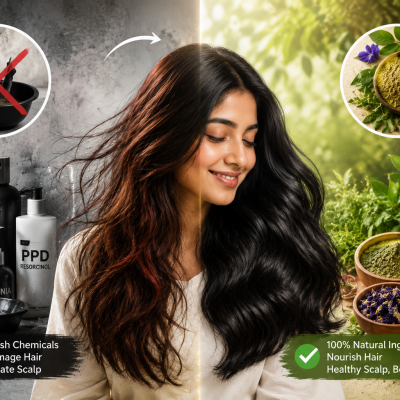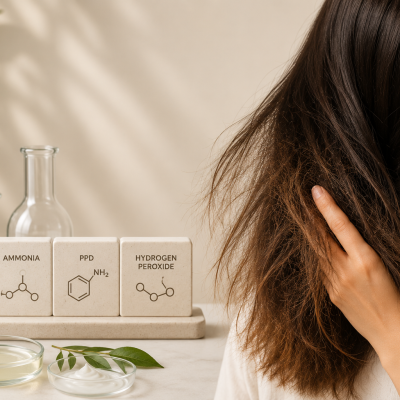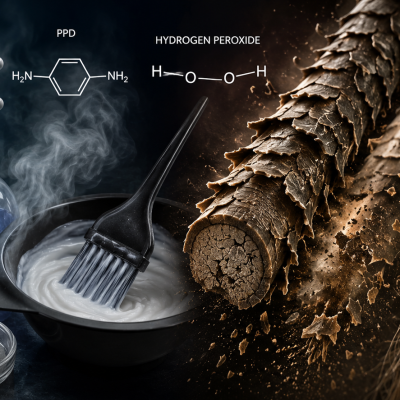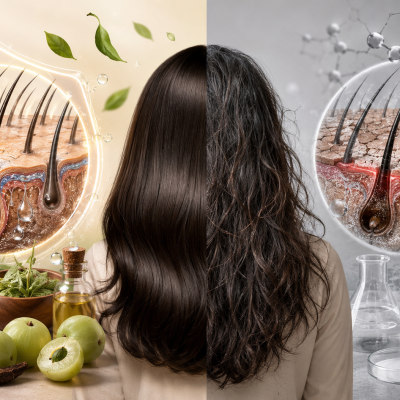
How to get rid of dandruff naturally is a question many people struggle with, especially when harsh shampoos fail to provide lasting relief. Modern microbiological and dermatological science indicates that dandruff is not merely a surface level dryness but a critical bio-indicator of a fundamentally disrupted scalp ecosystem. Instead of repeatedly stripping the scalp, a better approach is to restore its natural balance using gentle, plant-based cleansers that support long-term scalp health (Wei et al., 2020; Borda et al., 2015). Read More.
Let's Discuss
1. A Smarter, Natural Approach to Scalp Care
Moving to a scalp-first approach means shifting away from quick fixes and focusing on restoring balance. Instead of relying on harsh chemicals, the idea is to use ingredients that your scalp naturally understands and can work with.
1.1 Stop the Damage First
The first step is simple—remove harsh chemicals like sulfates and parabens. These ingredients strip away your scalp’s natural oils, causing dryness and irritation. When you stop using them, your scalp finally gets a chance to recover and regulate itself (Borda et al., 2015; Kanyama et al., 2025).
1.2 Switch to Gentle, Plant-Based Cleansing
Instead of chemical shampoos, natural cleansers like Reetha and Shikakai offer a much gentler alternative (Bhattacharyya, 2013; Upadhyay et al., 2020). They clean your scalp effectively without damaging its protective layer. Unlike synthetic products, they don’t leave behind buildup or disrupt your scalp’s balance.
1.3 Nourish from Within
Healthy hair starts internally. Staying hydrated and eating a balanced, low-processed diet helps regulate oil production and supports overall scalp health. When your body is balanced, your scalp reflects it (Wei et al., 2020; Chen et al., 2023).
1.4 Keep Your Routine Simple
Using too many products can clog your scalp and block hair follicles. A minimalist routine—avoiding heavy styling products and buildup—allows your scalp to breathe and function naturally (Zouboulis et al., 2020; Matard et al., 2013).
1.5 Be Consistent
Natural care works differently from quick-fix products. It doesn’t give instant results but focuses on long-term improvement. With consistent use, your scalp gradually restores its balance, reducing issues like dandruff and irritation at the root level (Blanpain et al., 2009; Kilgour, 2023). Learn more.
2. The Power of Herbal Ingredients
Natural ingredients bring multiple benefits without side effects.
Together, these herbs work in harmony—not just to clean your hair, but to repair, protect, and restore your scalp over time.
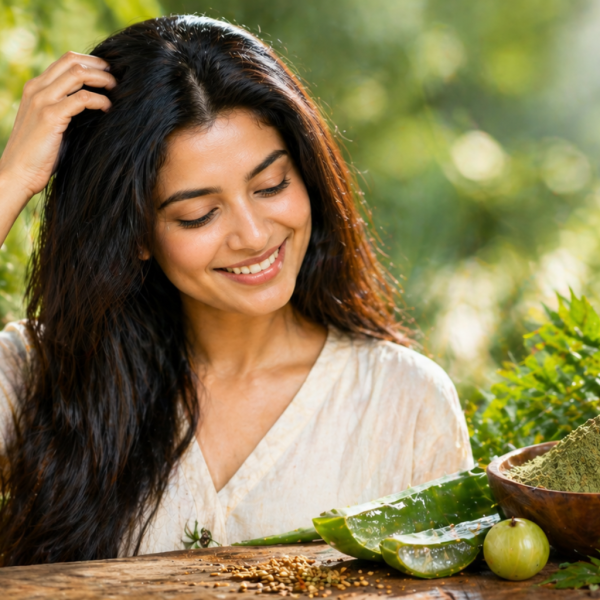
- Reetha (Soapnut): A natural cleanser rich in saponins that gently removes dirt and excess oil without stripping the scalp. It also helps reduce dandruff-causing microbes and can improve flaking and itchiness over time (Upadhyay et al., 2020).
- Shikakai: A mild, pH-balancing cleanser that supports the scalp’s natural acid layer while preventing dryness, frizz, and breakage (Sunar et al., 2023; Pingili et al., 2016).
- Neem: Known for its strong antifungal and anti-inflammatory properties, it helps control dandruff at the root by reducing microbial overgrowth and soothing irritation (Pingili et al., 2016; Patel et al., 2024).
- Curry Leaves: Rich in antioxidants and nutrients that support scalp health, improve circulation, and strengthen hair from the roots (Patel et al., 2024).
- Fenugreek (Methidana): Deeply hydrates and conditions the scalp, repairs dryness, and strengthens hair roots to reduce breakage and hair fall (Patel et al., 2024).
- Amla: A powerful antioxidant that protects the scalp, supports hair growth, and helps regulate excess oil production (Baliga et al., 2011; Thakur et al., 1989).
- Aloe Vera: Soothes irritation, reduces redness, and helps repair the scalp barrier while maintaining moisture balance (Pingili et al., 2016; Thakur et al., 1989).
👉 Switching to Fusion of Herbs, which combines all these powerful botanicals, helps restore scalp balance naturally—without stripping—while still providing effective, gentle cleansing. Read More
👉 Dandruff improves not by removing flakes, but by restoring the scalp’s natural microbiome and barrier function (Borda et al., 2015; Wei et al., 2020).
Join the Journey Back to Natural Hair Care
We are building more than just products—we are building a community
that believes in thoughtful, effective, and responsible hair care.
3. Conclusion - How to Get Rid of Dandruff Naturally: A Scalp-First Approach
Dandruff is not just a surface problem—it’s a sign of imbalance. The real solution isn’t using stronger shampoos, but adopting a simpler, gentler approach. When you switch to herbal, non-stripping care, you allow your scalp to function naturally, break the recurring dandruff cycle, and support long-term hair health. Sometimes, true healing begins not by adding more, but by simplifying what you already do.
👉 Plant-based cleansers work with the scalp—not against it—providing effective cleansing without disrupting its natural balance or causing rebound effects.
4. FAQ: Expert Insights
Can dandruff be cured permanently?
Not exactly. Dandruff is caused by a yeast that naturally lives on your scalp, so it can’t be completely removed. However, by maintaining a healthy scalp balance and avoiding harsh products, you can control it so well that flakes and irritation rarely come back.
Is oiling good for dandruff?
It depends. Applying heavy oils on an oily or dandruff-prone scalp can worsen the problem, as the yeast feeds on excess oil. However, lighter oils with ingredients like Neem or Fenugreek can help if used correctly. In most cases, gentle herbal cleansing is more effective for restoring balance.
Why does dandruff keep coming back?
Because the root cause isn’t being addressed. If you only remove visible flakes but continue using harsh shampoos, the imbalance remains. This creates a cycle where dandruff keeps returning. Long-term results come from a consistent, gentle routine that supports your scalp’s natural health. Read more.
5. References:
- Baliga, M.S. and Dsouza, J.J. (2011) ‘Amla (Emblica officinalis Gaertn), a wonder berry in the treatment and prevention of cancer’, European Journal of Cancer Prevention, 20(3), pp. 225–239. Available at: https://pmc.ncbi.nlm.nih.gov/articles/PMC3326920/
- Bhattacharyya, D. (2013) ‘Natural saponins as effective cleansing agents’, Journal of Natural Products. Available at: https://www.researchgate.net/publication/257720573
- Blanpain, C. and Fuchs, E. (2009) ‘Epidermal homeostasis: a balancing act of stem cells in the skin’, Nature Reviews Molecular Cell Biology, 10(3), pp. 207–217. Available at: https://www.nature.com/articles/nrm2636
- Borda, L.J. and Wikramanayake, T.C. (2015) ‘Seborrheic dermatitis and dandruff: a comprehensive review’, Journal of Clinical and Investigative Dermatology, 3(2). Available at: https://www.ncbi.nlm.nih.gov/pmc/articles/PMC4852869/
- Chen, Y. et al. (2023) ‘Sebum, scalp microbiome, and inflammatory responses in dandruff pathogenesis’, International Journal of Molecular Sciences. Available at: https://www.mdpi.com/1422-0067/24/5/4827
- Kanyama, N. et al. (2025) ‘Surfactant-containing detergents: Impacts on dermal health’, Colloids and Surfaces B: Biointerfaces. Available at: https://www.sciencedirect.com/science/article/abs/pii/S0927776525005338
- Kilgour, E. (2023) ‘Understanding skin barrier repair and scalp health’, Dermatology Reports. Available at: https://www.pagepress.org/journals/index.php/dr/article/view/
- Matard, B. et al. (2013) ‘Hair care products and their impact on scalp health’, Clinical, Cosmetic and Investigational Dermatology, 6, pp. 281–292. Available at: https://www.ncbi.nlm.nih.gov/pmc/articles/PMC3944653/
- Patel, S. et al. (2024) ‘Traditional herbal ingredients and their therapeutic properties for scalp health’, Journal of Ethnopharmacology. Available at: https://www.academia.edu/127508464/Ethnopharmacology_and_hair_Indian_perspectives
- Pingili, R.B. et al. (2016) ‘Evaluation of herbal extracts for antidandruff activity’, International Journal of Pharmaceutical Sciences Review and Research. Available at: https://www.researchgate.net/publication/301696202
- Sunar, S. et al. (2023) ‘pH analysis of commercial shampoos and their effects on hair and scalp’, International Journal of Cosmetic Science. Available at: https://pubmed.ncbi.nlm.nih.gov/
- Thakur, M. et al. (1989) ‘Hair growth promoting activity of Phyllanthus emblica’, Journal of Ethnopharmacology, 25(1), pp. 29–34. Available at: https://pubmed.ncbi.nlm.nih.gov/
- Upadhyay, R.K. et al. (2020) ‘Sapindus mukorossi (Reetha): phytochemistry and biological activity’, Pharmacognosy Reviews, 14(27), pp. 1–8. Available at: https://www.ncbi.nlm.nih.gov/pmc/articles/PMC
- Wei, Y. et al. (2020) ‘Diet, microbiome, and inflammatory skin conditions’, Frontiers in Microbiology, 11. Available at: https://www.frontiersin.org/articles/10.3389/fmicb.2020.
- Zouboulis, C.C. et al. (2020) ‘Sebaceous gland function and disorders’, Dermato-Endocrinology, 12(1). Available at: https://www.ncbi.nlm.nih.gov/pmc/articles/PMC