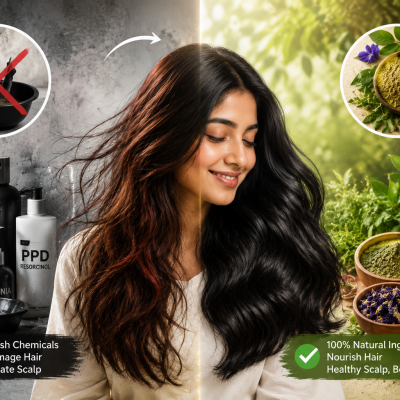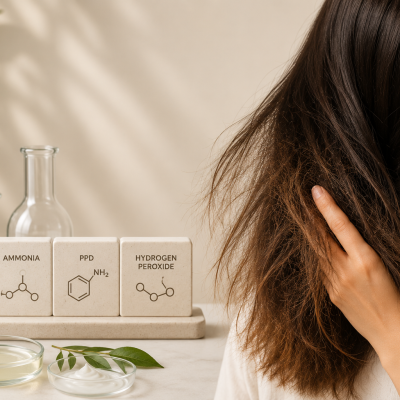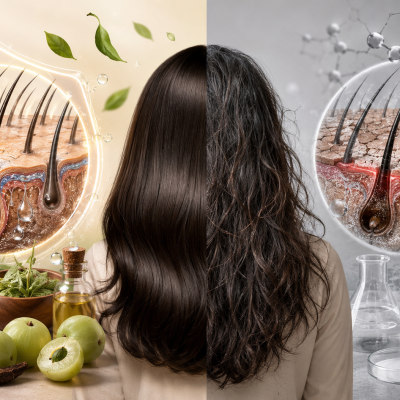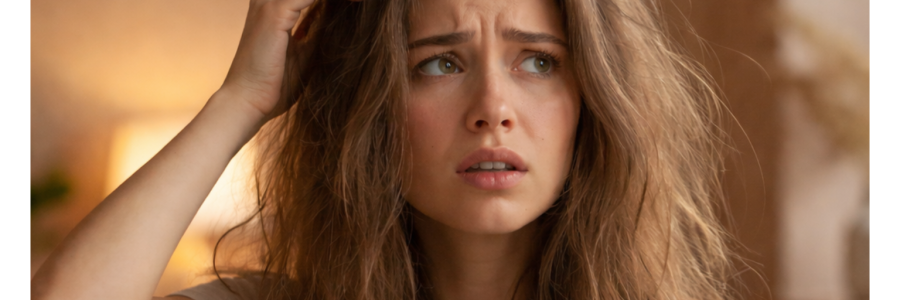
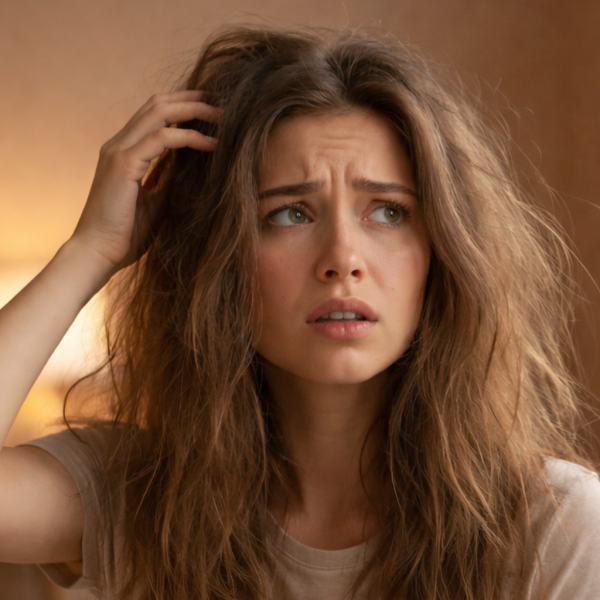
Have you ever thought what causes Frizzy Hair? The way we’ve been taught to care for our hair is slowly being questioned—and for good reason. For years, most products have focused only on making hair look smooth, shiny, and reducing Frizzy Hair on the surface using strong cleansing agents and coating ingredients (Dias, 2015). While these give quick results, research shows they often damage hair over time by drying it out, weakening its structure, and exhausting the hair roots (Adav et al., 2025). This is why many people feel stuck in a cycle where their hair never truly improves.
This issue becomes even more noticeable between the ages of 30 and 50, when natural body changes, along with years of heat styling, pollution, and daily wear and tear, start affecting hair health (Adav et al., 2025). What we commonly call Frizzy Hair is not just a styling concern—it’s actually a sign that your hair is losing moisture, its natural protective oils, and structural strength (Tokunaga et al., 2019).
This issue becomes even more noticeable between the ages of 30 and 50, when natural body changes, along with years of heat styling, pollution, and daily wear and tear, start affecting hair health (Adav et al., 2025). What we commonly call “frizz” is not just a styling concern—it’s actually a sign that your hair is losing moisture, its natural protective oils, and structural strength (Tokunaga et al., 2019).
Let's Discuss
- 1. Understanding Hair Structure and Why Frizz Happens
- 2. The Hair Damage Cycle: How Shampoos and Conditioners Can Make Things Worse
- 3. Why pH Balance is Important for Healthy, Frizz-Free Hair
- 4. How Daily Habits and Environment Damage Your Hair
- 5. How Age and Hormones Affect Hair (Women 30–50)
- 6. Conclusion
- 7. References
1. Understanding Hair Structure and Why Frizz Happens
To understand frizz and dryness, it helps to know how a strand of hair is built. Each hair has three main layers—the inner medulla, the middle cortex, and the outer cuticle (Jones & Rivett, 1997). These layers work together to give hair its strength, smoothness, and appearance.
1.1 The Cuticle and Its Natural Protective Layer
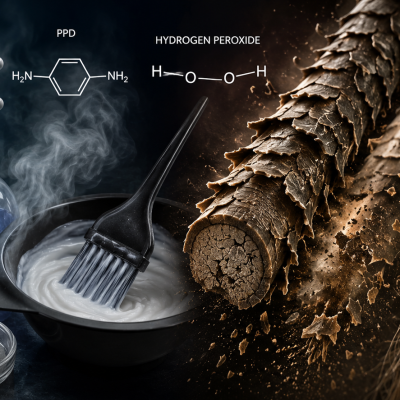
The cuticle is the outermost layer and acts like a shield, protecting your hair from damage. It is made up of overlapping cells, similar to roof tiles (Jones & Rivett, 1997). On top of this layer is a natural coating of lipids, mainly something called 18-MEA, which keeps hair smooth, shiny, and resistant to moisture (Breakspear et al., 2005; Tokunaga et al., 2019).
When this protective layer is intact, hair looks healthy and feels smooth. But when it gets damaged—due to harsh shampoos, chemicals, or sun exposure—it cannot repair itself. The hair then becomes rough, dry, and more prone to frizz (Tokunaga et al., 2019).
1.2 How Moisture Causes Frizz
Inside the hair is the cortex, which gives hair its strength and shape (Togashi et al., 2024). This layer contains proteins held together by different types of bonds. Some are strong and permanent, while others (called hydrogen bonds) are weaker and easily affected by water (Togashi et al., 2024).
When the outer protective layer is damaged, moisture from the air easily enters the hair. This breaks the weaker bonds and causes the hair to swell unevenly. As a result, strands bend and lose their shape—this is what we see as frizz (Togashi et al., 2024).
1.3 Why Repeated Wetting Damages Hair
Hair goes through stress every time it gets wet and dries again. This repeated swelling and shrinking is called “hygral fatigue” (Ruetsch et al., 2001). Over time, it weakens the inner structure of the hair, causing tiny cracks and lifting of the cuticle.
Damaged hair becomes more porous, weak, and difficult to manage. It absorbs water too quickly and loses it just as fast, leading to constant dryness, roughness, and lack of elasticity (Ruetsch et al., 2001).
In simple terms, frizz is not just a surface issue—it is a sign that your hair’s natural protective layer is damaged and unable to maintain proper moisture balance.
2. The Hair Damage Cycle: How Shampoos and Conditioners Can Make Things Worse
👉 Harsh shampoos damage your hair, and conditioners only hide that damage temporarily. This “strip and coat” cycle is one of the biggest reasons behind dryness, frizz, and long-term hair problems.
Join the Journey Back to Natural Hair Care
We are building more than just products—we are building a community
that believes in thoughtful, effective, and responsible hair care.
Most modern hair care products follow a simple pattern—first they strip, then they coat. Shampoos use strong chemicals to remove oil and dirt, and conditioners add a smooth coating to make hair feel soft again. While this gives quick results, it actually creates a cycle that damages hair over time and makes you dependent on more products.
2.1 Harsh Shampoos and Loss of Natural Oils
Many shampoos contain strong cleansing agents like SLS and SLES. These create a lot of foam and clean well, but they are also very harsh on your hair and scalp (De Paepe et al., 2002).
They don’t just remove dirt—they also strip away your hair’s natural oils and protective layer. This leads to dryness, rough texture, static, and frizz (De Paepe et al., 2002).
At the same time, they damage your scalp by weakening its natural barrier and increasing moisture loss. In response, your scalp produces even more oil to protect itself. This is why your hair quickly becomes oily again after washing (De Paepe et al., 2002).
So, you wash more often, which causes more dryness and more oil production—creating a continuous cycle of damage.
2.2 The False Smoothness of Silicones
To fix the dryness and frizz caused by shampoos, conditioners and serums use ingredients like silicones (for example, dimethicone). These coat your hair and make it feel smooth and shiny instantly (Cheng et al., 2020).
But this is only a temporary effect. Silicones form a layer on the hair that blocks real moisture from entering. Over time, your hair becomes dry and weak from the inside, even though it looks smooth on the outside (Cheng et al., 2020).
They also build up on your hair and scalp, making hair heavy, dull, and harder to manage. This buildup can clog hair follicles and may affect healthy hair growth. To remove it, you often need stronger shampoos again—bringing you right back into the same damage cycle (Cheng et al., 2020).
3. Why pH Balance is Important for Healthy, Frizz-Free Hair
ne of the most important (but often ignored) factors for healthy hair is pH balance. Your scalp naturally has a slightly acidic pH of around 5.5, and your hair is even more acidic (Adav et al., 2025). This acidity helps keep your hair smooth, strong, and protected.
When you use products that are too alkaline (pH above 7)—like many shampoos and chemical treatments—they disturb this natural balance. This causes the outer layer of your hair (cuticle) to open up and lift (Gavazzoni Dias et al., 2014).
When the cuticle is open:
- Hair becomes rough and tangled
- Moisture escapes quickly, leading to dryness
- The inner part of the hair gets exposed and damaged
- Frizz increases because hair absorbs excess humidity
On the other hand, when you use slightly acidic products (pH 4.5–5.5), the cuticle stays closed and smooth (Gavazzoni Dias et al., 2014). This helps:
- Lock in moisture
- Reduce frizz
- Add natural shine
- Protect hair from damage
In simple terms:
Balanced pH keeps your hair smooth and healthy, while high pH products make it rough, dry, and frizzy.
👉 In simple terms: Balanced pH keeps your hair smooth and healthy, while high pH products make it rough, dry, and frizzy.
4. How Daily Habits and Environment Damage Your Hair
Hair damage doesn’t come only from products—your daily habits and surroundings also play a big role. Simple things like heat styling or the type of water you use can slowly weaken your hair and make frizz worse over time.
4.1 Heat Damage: Why Styling Tools Harm Your Hair
Using heat tools like blow dryers, straighteners, or curling irons on wet or damp hair can seriously damage your hair (Savitha et al., 2011). When your hair is wet, it holds water inside. If you apply high heat, this water quickly turns into steam.
Because the steam has nowhere to go, it creates tiny bubbles inside the hair strand. This is called “bubble hair” (Savitha et al., 2011). These bubbles damage the inner structure of your hair, making it weak, rough, and very frizzy.
Once this damage happens, it cannot be repaired. Hair becomes stiff, breaks easily, and loses its smooth texture (Detwiler et al., 1994). The only real solution is to cut off the damaged part.
4.2 Hard Water: The Hidden Cause of Frizz and Hair Fall
The quality of water you use also affects your hair. In many areas, especially cities, the water is “hard,” meaning it contains high levels of minerals like calcium and magnesium (Srinivasan et al., 2013).
When you wash your hair with hard water regularly, these minerals stick to your hair and scalp, causing several problems:
- Product buildup: Minerals react with shampoo and form a residue on your hair, making it feel rough and heavy.
- More frizz: These deposits lift the hair cuticle, making hair dry, tangled, and dull.
- Scalp issues: Minerals can clog hair follicles, leading to irritation, itching, and even increased hair fall (Srinivasan et al., 2013).
Over time, this buildup makes hair harder to manage and reduces the effectiveness of conditioners and treatments.
In short, even if you use good products, habits like excessive heat styling and exposure to hard water can quietly damage your hair. Protecting your hair from these everyday stressors is just as important as choosing the right hair care routine.
5. How Age and Hormones Affect Hair (Women 30–50)
Hair problems are not just caused by products or environment—your body also plays a big role. For women between 30 and 50, hormonal changes can significantly affect hair health.
During this phase (perimenopause), estrogen levels start to drop (Glaser et al., 2012). Estrogen is important because it supports hair growth, thickness, and natural oil production. When it decreases, several changes happen:
- Thinner hair: Hair follicles shrink, so new hair grows finer and weaker.
- More dryness: The scalp produces less natural oil, making hair dry, rough, and prone to breakage.
- Increased hair fall: The growth cycle slows down, leading to more shedding and reduced volume (Glaser et al., 2012).
Over time, these natural changes combine with years of heat styling, chemical treatments, and harsh shampoos, making hair more fragile and difficult to manage.
Because of this, many women are now moving away from heavy, chemical-based products. Instead, they prefer simpler, natural, and scalp-focused routines that actually support long-term hair health rather than just giving temporary smoothness (Glaser et al., 2012).
6. Conclusion
Dry and frizzy hair is rarely natural—it is mostly the result of repeated damage caused by harsh shampoos, product buildup, heat styling, hard water, and environmental stress (Dias, 2015; Adav et al., 2025). Over time, these factors strip away the hair’s natural protective layer, disrupt moisture balance, and weaken its internal structure. What we commonly call “frizz” is actually a visible sign of this deeper damage—loss of hydration, rough cuticles, and reduced strength (Tokunaga et al., 2019).
This is why quick-fix products often fail to deliver long-term results—they only smooth the surface without addressing the root cause. To truly improve hair health, a more balanced and holistic approach is needed. This is where the idea of combining multiple natural ingredients—rather than relying on a single solution—begins to make sense, laying the foundation for a more effective, herb-based approach to hair care.
7. References:
- Adav, S.S., Wu, A.R.Y.L. and Ng, K.W., 2025. Insights into structural and proteomic alterations related to pH-induced changes and protein deamidation in hair. International Journal of Cosmetic Science, 47(2), pp.281–296.
Available at: https://onlinelibrary.wiley.com/doi/10.1111/ics.12874 - Breakspear, S., Smith, J.R. and Luengo, G., 2005. Effect of the covalently linked fatty acid 18-MEA on the nanotribology of hair’s outermost surface. Journal of Structural Biology, 149(3), pp.235–242.
Available at: https://www.sciencedirect.com/science/article/pii/S1047847704001723 - Cheng, W., Kai, D., Loh, X.J. and He, C., 2020. Silicone copolymers for healthcare and personal care applications. Silicon Containing Hybrid Copolymers, pp.1–25.
Available at: https://www.sciencedirect.com/science/article/pii/B9780128200148000010 - De Paepe, K., Hachem, J.P., Vanpee, E., Roseeuw, D. and Rogiers, V., 2002. Effect of ceramides on barrier repair of SLS-induced skin damage. Journal of the European Academy of Dermatology and Venereology, 16(6), pp.587–594.
Available at: https://onlinelibrary.wiley.com/doi/10.1046/j.1468-3083.2002.00469.x - Detwiler, S.P., Carson, J.L., Meyer, A.W. and Roberts, J.L., 1994. Bubble hair: Case caused by an overheating hair dryer and reproducibility in normal hair with heat. Journal of the American Academy of Dermatology, 30(1), pp.54–60.
Available at: https://www.jaad.org/article/S0190-9622(94)70008-4/fulltext - Dias, M.F.R.G., 2015. Hair cosmetics: An overview. International Journal of Trichology, 7(1), pp.2–15.
Available at: https://www.ncbi.nlm.nih.gov/pmc/articles/PMC4387693/ - Gavazzoni Dias, M.F., Pichler, J., Adriano, A., Cecato, P. and de Almeida, A., 2014. The shampoo pH can affect the hair: Myth or reality? International Journal of Trichology, 6(3), pp.95–99.
Available at: https://www.ncbi.nlm.nih.gov/pmc/articles/PMC4158629/ - Glaser, R.L., Dimitrakakis, C. and Guy, J., 2012. Testosterone implant therapy in women with and without breast cancer: Rationale, experience, evidence. Maturitas, 71(3), pp.228–233.
Available at: https://www.sciencedirect.com/science/article/pii/S0378512211003287 - Jones, L.N. and Rivett, D.E., 1997. The role of 18-methyleicosanoic acid in the structure and formation of mammalian hair fibres. Micron, 28(6), pp.469–485.
Available at: https://www.sciencedirect.com/science/article/pii/S0968432897000319 - Ruetsch, S.B., Kamath, Y.K., Rele, A.S. and Mohile, R.B., 2001. Secondary ion mass spectrometric investigation of penetration of oils into human hair fibers: Relevance to hair damage. Journal of Cosmetic Science, 52(3), pp.169–184.
Available at: https://library.scconline.org/v052n03/15 - Savitha, A.S., Sacchidanand, S. and Mallikarjun, M., 2011. Bubble hair and other acquired hair shaft anomalies due to hot ironing on wet hair. International Journal of Trichology, 3(2), pp.118–120.
Available at: https://www.ncbi.nlm.nih.gov/pmc/articles/PMC3150165/ - Srinivasan, G., Srinivas, C.R., Mathew, A.C. and Duraiswami, D., 2013. Effects of hard water on hair. International Journal of Trichology, 5(3), pp.137–139.
Available at: https://www.ncbi.nlm.nih.gov/pmc/articles/PMC3927171/ - Togashi, T., Uesaka, T. and Kureha, Y., 2024. Analysis of swelling behaviour of human hair during permanent waving treatment. Biophysical Chemistry, 305, p.107364.
Available at: https://www.sciencedirect.com/science/article/pii/S0301462223001505 - Tokunaga, S., Tanamachi, H. and Ishikawa, K., 2019. Degradation of hair surface: Importance of 18-MEA and epicuticle. Cosmetics, 6(2), p.31.
Available at: https://www.mdpi.com/2079-9284/6/2/31