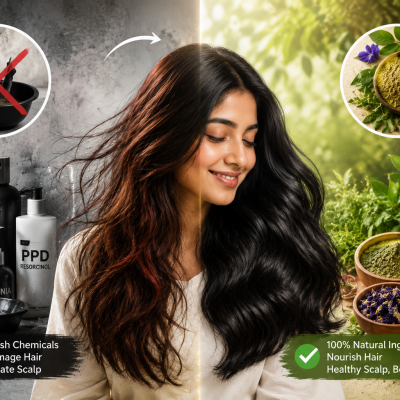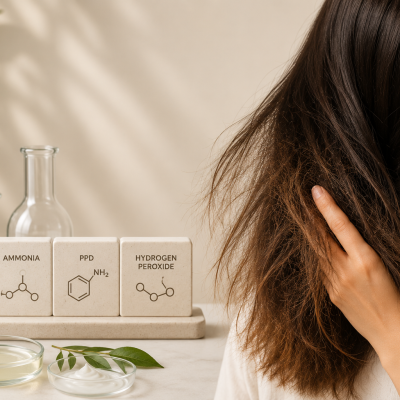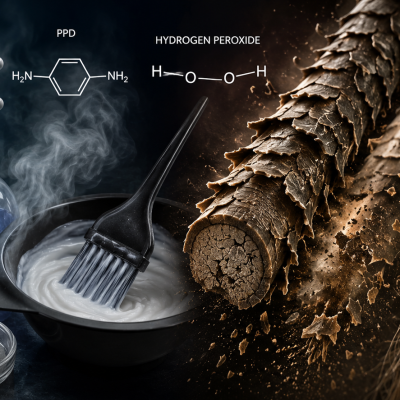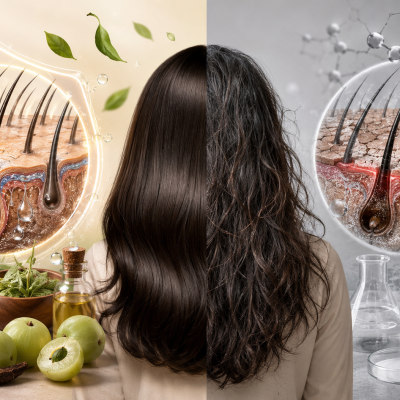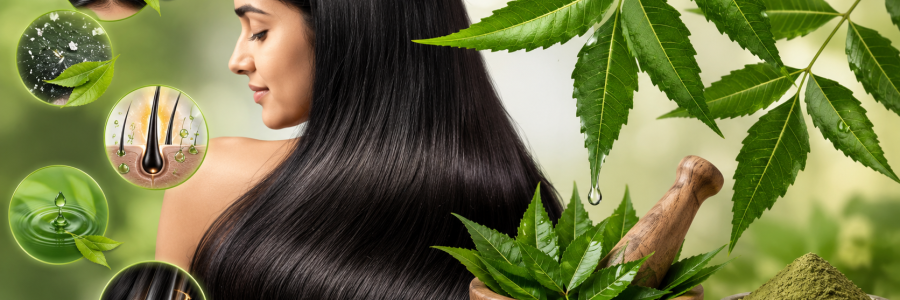
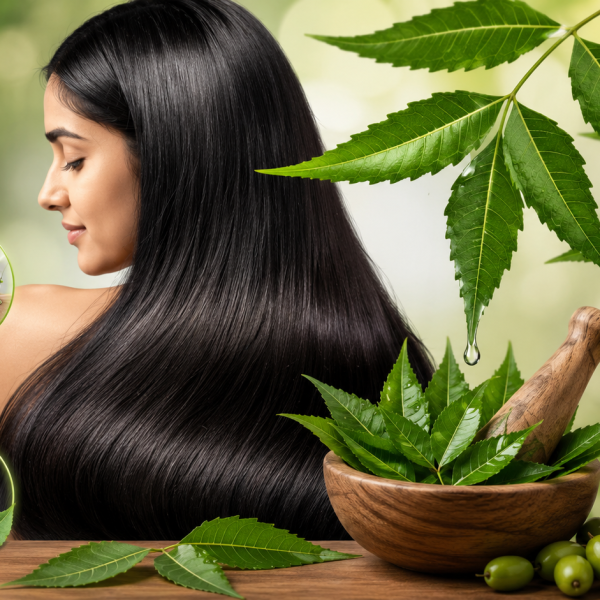
The personal care and hair care industry is rapidly shifting toward “clean beauty,” with consumers increasingly choosing natural and plant-based products over harsh chemical formulations for better scalp and long-term hair health (Sang et al., 2023; Hashem et al., 2024; Vyansa Intelligence, 2026). Traditional Indian herbs are regaining importance as safer and scientifically supported solutions for healthy hair and scalp maintenance (Sang et al., 2023). Among them, Neem (Azadirachta indica) leaf powder stands out for its powerful therapeutic and scalp-protective properties (Hashem et al., 2024).
When combined with other herbs in a balanced “Fusion of Herbs” formulation, Neem can provide an effective and nourishing hair care solution (Sang et al., 2023; Kumar et al., 2012). This report examines the scientific, dermatological, and market-related aspects of Neem-based herbal hair wash powders, comparing the harmful effects of synthetic shampoos with the benefits of herbs such as Neem, Shikakai (Acacia concinna), Reetha (Sapindus mukorossi), Amla (Phyllanthus emblica), Fenugreek (Trigonella foenum-graecum), and Curry Leaves (Murraya koenigii). The aim is to encourage a shift toward safer herbal alternatives that support long-term hair health and strength (Sang et al., 2023; Kumar et al., 2012; Dusane & Joshi, 2012).
Let's Discuss
1. Growing Demand for Ayurvedic Hair Care Products
The rapid growth of the Ayurvedic personal care market shows a major change in how people approach self-care and hair wellness. Ayurvedic products are no longer seen as only niche or traditional remedies. Today, they have become a regular part of daily hair care routines for people across different age groups and income levels (Vyansa Intelligence, 2026).
Consumer trust in Ayurvedic systems is also extremely high. According to survey data from the Ministry of Ayush, awareness about Ayush systems has reached 94.8% in rural India and 96% in urban areas (Vyansa Intelligence, 2026). This shows how strongly herbal and traditional wellness solutions are now accepted across the country.
Although synthetic ingredients such as SLS, parabens, and silicones still dominate a large share of the hair care market, the demand for natural and herbal alternatives is growing rapidly (MarkNtel Advisors, 2026). Modern consumers are becoming more careful about the ingredients used in their products. Many people now check ingredient lists, look for transparency, prefer GMP-certified products, and actively choose formulations that avoid harsh chemicals (Sang et al., 2023).
2. 5 Benefits of Neem for Hair Care
In natural and holistic hair care, the scalp is considered the foundation for healthy hair growth. Just like healthy soil is important for growing strong plants, a healthy scalp is essential for strong and healthy hair (Sang et al., 2023). If the scalp becomes damaged, dry, irritated, oily, or inflamed, hair health is also affected over time.
Neem (Azadirachta indica), also known as the Margosa tree, is one of the most powerful and trusted herbs used in traditional hair and scalp care. Neem helps maintain a healthy scalp environment by supporting oil balance, protecting the scalp’s moisture barrier, and reducing irritation without the harsh effects commonly caused by chemical shampoos (Hashim et al., 2021).
2.1 Anti-inflammatory properties
Neem is widely valued in natural medicine due to its rich composition of over 130 bioactive compounds found in its leaves, bark, seeds, and twigs (Hashem et al., 2024; Sang et al., 2023). Key compounds include azadirachtin, nimbin, nimbidin, nimbolinin, nimbidol, and nimbolide, along with antioxidants such as quercetin, catechin, epicatechin, and gallic acid (Hashem et al., 2024).
These compounds give Neem strong antimicrobial, anti-inflammatory, antioxidant, and soothing properties that support scalp and hair health (Hashem et al., 2024; Sadati et al., 2024). Compounds like nimbidin help reduce scalp irritation, redness, and itching, while azadirachtin may regulate inflammatory responses at the cellular level (Hashem et al., 2024; Sadati et al., 2024). Neem antioxidants also protect hair follicles from oxidative stress, pollution, and environmental damage that can weaken long-term hair health (Hashem et al., 2024; Sang et al., 2023).
2.2 Dandruff control
Dandruff and seborrheic dermatitis are commonly linked to the excessive growth of microorganisms such as the fungus Malassezia furfur and the bacterium Staphylococcus epidermidis on the scalp (Hashem et al). Read more
When the scalp becomes too oily or its natural barrier gets damaged—often due to repeated use of harsh shampoos—these microorganisms can grow excessively (Hashem et al., 2024). This may lead to irritation, itching, inflammation, and visible flakes on the scalp.
Scientific studies have shown that Neem has strong natural antifungal and antibacterial properties that help reduce the growth of these harmful microorganisms (Hashem et al., 2024). Research suggests that herbal formulations containing Neem can significantly lower the activity of Malassezia furfur and Staphylococcus epidermidis, helping restore a healthier scalp balance (Hashem et al., 2024).
2.3 Gentle Cleansing
Unlike many harsh commercial shampoos that can dry out the scalp and disturb its natural balance, Neem-based hair cleansing provides a gentler and more balanced approach to scalp care (Sang et al., 2023). Neem helps cleanse the scalp without excessively stripping away its natural oils, allowing the scalp to maintain a healthier moisture balance. Read More
2.4 Healthy Scalp Balance
Neem-based hair wash powders are also known for providing a “residue-free wash.” Many commercial shampoos and styling products leave behind layers of silicones and synthetic ingredients on the hair and scalp, which can build up over time and block hair follicles (Sang et al., 2023).
Neem helps remove this buildup naturally, leaving the scalp feeling cleaner, fresher, and healthier.
2.5 Healthier hair growth
By keeping the scalp clean and reducing product buildup, Neem may help create a better environment for healthy hair growth and normal hair cycle function (Sang et al., 2023).
👉 Because of its natural antibacterial, antifungal, and soothing properties, Neem is widely valued for maintaining scalp cleanliness and comfort while supporting overall hair health (Hashim et al., 2021). Unlike many harsh detergents, Neem works gently with the scalp instead of stripping away its natural protective oils.
Join the Journey Back to Natural Hair Care
We are building more than just products—we are building a community
that believes in thoughtful, effective, and responsible hair care.
3. The Power of Combining Multiple Herbs
While Neem alone offers many benefits for hair and scalp health, herbal formulations become even more effective when multiple beneficial herbs are combined together (Sang et al., 2023). Both Ayurveda and modern plant science support the idea that different herbs can work together to provide broader and more balanced benefits.
A well-designed “Fusion of Herbs” formulation combines carefully selected herbs to support overall scalp health, hair strength, cleansing, nourishment, and moisture balance at the same time. By blending Neem with herbs such as Amla, Reetha, Shikakai, Fenugreek (Methidana), Aloe Vera, and Curry Leaves, formulators can create a complete herbal hair care system that addresses multiple aspects of hair wellness naturally (Kumar et al., 2012; Sang et al., 2023).
Each herb contributes its own unique properties. Some herbs help cleanse the scalp gently, some support nourishment and conditioning, while others help maintain moisture, shine, and scalp comfort. Read More
👉 Together, these herbs create a balanced and holistic approach to healthy hair care without relying on harsh chemicals.
4. Modern Herbal Hair Care for Safe and Long-Term Scalp Wellness
Traditional Ayurvedic hair washes often required soaking, grinding, and boiling herbs, making them inconvenient for regular modern use (Sang et al., 2023). Older herbal powders were also coarse and difficult to rinse (Sang et al., 2023; Hashem et al., 2024). Modern “Fusion of Herbs” formulations solve these challenges through advanced processing and fine micronization, creating smoother powders that can be easily used through a simple “Mix – Shake – Apply” method.
The growing clean beauty movement has further increased demand for safer and gentler hair care solutions (Sang et al., 2023). Many modern herbal formulations are designed to be sulfate-free, paraben-free, preservative-free, and fragrance-free to reduce unnecessary chemical exposure. Avoiding sulfates may help protect the scalp’s natural moisture barrier (Friebe et al., 2003; Jurek et al., 2021), while dry herbal powders naturally require fewer preservatives because of their low moisture content (Sang et al., 2023).
By combining Ayurvedic knowledge with modern processing techniques, “Fusion of herbs” offer cleaner, practical, and user-friendly solutions that support long-term scalp and hair wellness.
5. References
- Dusane, M.B. and Joshi, B.N. (2012) ‘Islet protective and insulin secretion property of Murraya koenigii and Ocimum tenuflorum in streptozotocin-induced diabetic mice’, Canadian Journal of Physiology and Pharmacology, 90(3), pp. 371–378. Available at: https://cdnsciencepub.com/doi/abs/10.1139/y11-133
- Friebe, K., Effendy, I. and Loffler, H. (2003) ‘Effects of Sodium Lauryl Sulfate on Skin Barrier Dysfunction and Transepidermal Water Loss’, Acta Dermato-Venereologica, 83(6). Available at: https://medicaljournalssweden.se/actadv/article/view/16914
- Hajizadeh, A. et al. (2022) ‘Herbal gel from fenugreek seed reduces the incidence of hair loss and trichoptilosis’, Journal of Cosmetic Dermatology. Available at: https://pmc.ncbi.nlm.nih.gov/articles/PMC11016425/
- Hashem, M.M. et al. (2024) ‘Rosemary and neem: an insight into their combined anti-dandruff and anti-hair loss efficacy’, Scientific Reports, 14(1), p. 7780. Available at: https://pmc.ncbi.nlm.nih.gov/articles/PMC10987638/
- Hashim, A. et al. (2021) ‘Extraction techniques of neem and their utilization’, Journal of Plant Sciences. Available at: https://pmc.ncbi.nlm.nih.gov/articles/PMC12400164/
- Imtiaz, F. et al. (2017) ‘Impact of Trigonella foenum-graecum leaves extract on mice hair growth’, Pakistan Journal of Zoology, 49(4), pp. 1405–1412. Available at: https://pmc.ncbi.nlm.nih.gov/articles/PMC12115063/
- Jurek, I. et al. (2021) ‘Soapwort Saponaria officinalis L. Extract vs. Synthetic Surfactants—Effect on Skin-Mimetic Models’, Molecules, 26(18), p. 5628. Available at: https://pubmed.ncbi.nlm.nih.gov/34577098/
- Kumar, N. et al. (2012) ‘5α-reductase inhibition and hair growth promotion of some Thai plants traditionally used for hair treatment’, Journal of Ethnopharmacology, 139(3), pp. 765–771. Available at: https://pmc.ncbi.nlm.nih.gov/articles/PMC5429933/
- Madhavi, M.S.L. et al. (2025) ‘Hair growth efficacy and safety assessment of an ayurvedic leave-on treatment: a clinical trial’, International Journal of Research in Dermatology, 11(6), pp. 518–526. Available at: https://www.ijord.com/index.php/ijord/article/view/2100
- MarkNtel Advisors (2026) India Hair Care Products Market Report. Available at: https://www.marknteladvisors.com/research-library/india-hair-care-products-market-report.html
- Sadati, M.S. et al. (2024) ‘Efficacy of topical rosemary extract lotion versus topical 2% ketoconazole lotion in the treatment of seborrheic dermatitis’, Dermatology Practical & Conceptual, 14(4), e2024242. Available at: https://dpcj.org/index.php/dpc/article/download/4449/2900/75800
- Sang, S.H. et al. (2023) ‘Natural alternatives from your garden for hair care: Revisiting the benefits of tropical herbs’, Heliyon, 9(11), e21876. Available at: https://pmc.ncbi.nlm.nih.gov/articles/PMC10685248/
- Vyansa Intelligence (2026) India Ayurvedic Personal Care Products Market Statistics and Insights. Available at: https://www.vyansaintelligence.com/industry-report/india-ayurvedic-personal-care-products-market-trend